If you’ve noticed more hair snapping when you detangle, wash, style, or even run your hands through your hair, you’re probably wondering what changed.
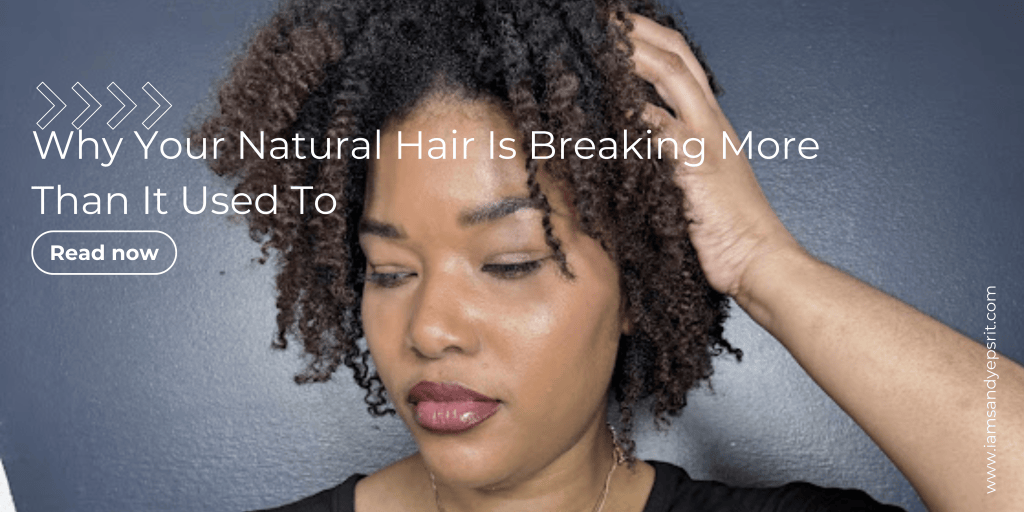
Maybe your hair used to feel stronger. Maybe you were finally seeing length, and suddenly it seems like you’re losing all of your progress. Or maybe your curls don’t look or feel the way they used to.
Hair breakage can be frustrating, especially when you’re doing everything you think you’re supposed to be doing.
But here’s the thing: natural hair doesn’t suddenly start breaking for no reason.
Usually, something has changed.
It could be how you’re styling your hair, how often you’re using heat, how you’re detangling, the condition of your ends, the products you’re using, or simply how much manipulation your hair is experiencing.
And sometimes, the biggest problem isn’t one single thing. It’s the combination of several small habits that eventually catch up with your hair.
If your natural hair is breaking more than it used to, here’s what I want you to look at.
What Is Hair Breakage?
Before we get into the causes, let’s talk about what we’re actually looking for.
Hair breakage happens when the hair shaft snaps somewhere along the length of the strand. Unlike shedding, where a hair naturally falls out from the root, breakage means the strand has broken before completing its normal growth cycle.
One of the easiest ways to tell the difference is to look at the hair you’re losing.
A naturally shed strand will usually be a longer strand, and you may notice a small bulb at one end. Broken hairs can be much shorter and may appear as random pieces of hair in your sink, on your clothing, in your comb, or around your bathroom.
You may also notice:
- Short pieces of hair around your sink or bathroom
- More hair on your hands after styling
- Uneven ends
- Split or frayed ends
- Your hair feeling rough or dry
- Difficulty retaining length
- Thinner looking ends
- Your curls becoming less defined in certain areas
If this sounds familiar, it’s time to look at what’s happening to your hair.
1. You’re Using More Heat Than Your Hair Can Handle
Let’s start with one of the biggest ones: heat.
Heat styling isn’t automatically bad for natural hair. Plenty of women with textured hair regularly straighten, blow dry, diffuse, or otherwise use heat without experiencing severe breakage.
The issue is how much heat your hair is exposed to and how you’re using it.
Repeated high heat can weaken the hair over time. This can become especially noticeable if you’re frequently wearing silk presses, using a flat iron, blow drying without proper protection, or repeatedly passing heat over the same section of hair.
And here’s something that doesn’t get talked about enough:
Heat damage doesn’t always happen all at once.
You may not walk away from one silk press thinking, “Wow, I just damaged my hair.”
Instead, the damage can accumulate.
Eventually, you may notice that your curls aren’t reverting the same way, your ends are becoming fragile, or your hair is snapping more easily.
If you’re currently wearing your hair straight more often, pay attention to what happens when you wash it again.
How to Stretch Natural Hair Safely With Heat (Without Heat Damage)
That’s also why your heat styling routine matters.
A good heat protectant doesn’t give you permission to use unlimited heat. Think of heat protection as one part of a bigger strategy that includes temperature, frequency, technique, and the condition of your hair.
2. Your Ends Are Older and More Fragile
Your ends are the oldest part of your hair.
That means they’ve been through everything.
Shampooing. Conditioning. Detangling. Sleeping. Styling. Hats. Scarves. Manipulation. Heat. Weather. Friction.
And if you’re trying to retain length, those ends have to survive long enough for you to actually see the growth you’re producing at the scalp.
This is where length retention becomes important.
Your hair can be growing perfectly well from your scalp while you continue to lose length because the ends are breaking faster than you’re retaining them.
You might look at your hair and think, “My hair isn’t growing.”
But sometimes the problem isn’t growth.
It’s retention.
Best Products for Length Retention on Type 4 Hair
If your ends are extremely thin, see-through, split, or constantly tangling, it may be time to consider a trim.
And no, trimming your hair doesn’t make it grow faster.
What trimming can do is remove damaged ends that are more likely to continue splitting and breaking.
3. You’re Detangling Too Aggressively
Let’s be honest.
Detangling natural hair can be a whole event.
And if you’re rushing through it, you may be putting a lot more stress on your strands than you realize.
Pulling through knots, ripping through tangles, starting at the roots, or using the wrong tool can cause unnecessary mechanical damage.
Instead, work in manageable sections and start closer to the ends before gradually working your way toward the roots.
Your hair should not sound like you’re opening a bag of chips every time you’re detangling it.
If you’re hearing constant snapping, stop.
Add more slip.
Separate the section.
Slow down.
And make sure you’re using a detangling method that works with your particular hair.
My Natural Hair Detangling Routine
4. Your Hair Is Too Dry
Dry hair is not automatically damaged hair, but hair that is consistently dry and difficult to manage can become more vulnerable to breakage.
If your hair feels rough, stiff, tangles easily, or seems to lose moisture almost immediately after wash day, your routine may need some adjusting.
That doesn’t necessarily mean you need ten new products.
Sometimes it’s about going back to the basics:
Cleanse. Condition. Moisturize. Protect. Handle gently.
Pay attention to how your hair responds rather than automatically adding another product to your routine.
Your hair doesn’t need to be drenched in oil to be healthy.
And oil isn’t the same thing as moisture.
Water and water-based products can help provide hydration, while oils and butters can help reduce moisture loss and provide lubrication.
The goal is finding a balance that works for your hair.
5. You’re Manipulating Your Hair Too Often
Sometimes the problem isn’t the products.
It’s the styling.
If you’re constantly putting your hair into a new style, restyling it every few days, slicking it down, brushing it, pulling it into tight ponytails, or constantly touching it, your hair is experiencing repeated mechanical stress.
Individually, these things may not seem like a big deal.
But repeated over time?
That’s different.
This is especially important around the hairline and edges, where the strands can be more vulnerable to tension.
If your hair is breaking around your temples, edges, or nape, take a look at how often those areas are being pulled, brushed, slicked, or manipulated.
Sometimes your hair is asking for less.
6. Your Protective Style May Not Actually Be Protecting Your Hair
Braids, twists, wigs, crochet styles, buns, and other low-manipulation styles can be useful ways to reduce daily handling.
But a style isn’t automatically protective just because we call it a protective style.
If your braids are too tight, your extensions are too heavy, your edges are constantly pulled, or you’re leaving a style in for too long without caring for your natural hair underneath, you can end up creating another source of breakage.
Your scalp shouldn’t hurt after installing a hairstyle.
And your edges shouldn’t have to sacrifice themselves for the look.
If a style causes pain, excessive tension, or noticeable breakage, it’s not working for your hair.
7. You’re Not Paying Attention to What Your Hair Is Telling You
This might be the biggest one.
We can become so focused on following a routine that we forget to actually observe our hair.
Your hair is going to tell you when something isn’t working.
Maybe your usual shampoo suddenly leaves your hair feeling stripped.
Maybe your favorite styling product is creating buildup.
Maybe you’re using protein frequently and your hair feels unusually stiff.
Maybe you’ve increased your heat styling because you love wearing your hair straight.
Maybe you’ve started exercising more and your wash routine has changed.
Maybe you’re simply manipulating your hair more because life has gotten busier.
Instead of asking, “What product do I need?”
Try asking:
“What changed?”
That’s often a much better place to start.
8. Your Hair Routine May Need to Change as Your Hair Changes
One of the biggest mistakes we make with natural hair is assuming that the routine that worked five years ago should still work today.
Your hair changes.
Your lifestyle changes.
Your styling habits change.
Your environment changes.
And sometimes your hair simply needs something different.
If you used to wear wash-and-gos every week but now you’re regularly heat styling, your routine needs to account for that.
If you used to wear your hair in low-manipulation styles but now you’re constantly restyling it, your routine needs to account for that too.
Don’t be afraid to adjust.
So, How Do You Stop Natural Hair From Breaking?
Start by figuring out why it’s breaking in the first place.
Before buying another product, look at your routine.
Ask yourself:
Am I using too much heat?
Am I being too rough when I detangle?
Are my ends damaged?
Am I constantly manipulating my hair?
Are my hairstyles too tight?
Is my hair consistently dry?
Have I changed something recently?
Am I actually retaining length?
You don’t have to completely overhaul your routine overnight.
Start with the biggest problem you identify and make one change at a time.
For example, if heat is the issue, focus on reducing your heat exposure and improving your heat styling technique.
If detangling is causing breakage, slow down and change your method.
If your ends are severely damaged, consider a trim and focus on protecting your new growth and remaining length.
If your hair is constantly dry, evaluate your cleansing, conditioning, and moisturizing routine.
Small changes can make a big difference when you stay consistent.
And Don’t Ignore Sudden or Severe Hair Loss
There’s an important difference between everyday breakage and significant hair loss.
If you’re experiencing sudden or excessive shedding, noticeable thinning, bald patches, scalp pain, inflammation, or other changes that concern you, don’t assume it’s simply because you have natural hair.
Hair loss can have many causes, including medical and nutritional factors.
A healthcare professional or dermatologist can help determine what’s actually happening.
Your hair routine can help with hair care, but it can’t diagnose an underlying medical condition.
The Bottom Line
If your natural hair is breaking more than it used to, don’t immediately panic and buy an entirely new collection of products.
Start by investigating what changed.
Your hair may be dealing with more heat, more manipulation, older ends, excessive tension, dryness, rough detangling, or a combination of several things.
And remember: healthy hair isn’t about having the longest hair, using the most expensive products, or following someone else’s routine perfectly.
It’s about understanding your hair and learning what helps you retain it.
For me, that’s become especially important as I’ve learned more about heat damage, length retention, and taking better care of my natural hair.
Because at the end of the day, I don’t want to simply grow my hair.
I want to keep the hair I grow.
And that’s the part of the natural hair conversation we don’t talk about enough.
MORE NATURAL HAIR ARTICLES
How to Tell If Your Natural Hair Has Heat Damage
How to Retain Length With Type 4 Natural Hair
My Silk Press Routine for Natural Hair
How Often Should You Wash Natural Hair?
Natural Hair Products I’ve Actually Finished
PIN THIS FOR LATER
If your natural hair has suddenly started breaking more than usual, save this post and use the checklist before changing your entire routine.
Your hair isn’t necessarily failing. It may just be telling you that something needs to change.


Leave a Reply