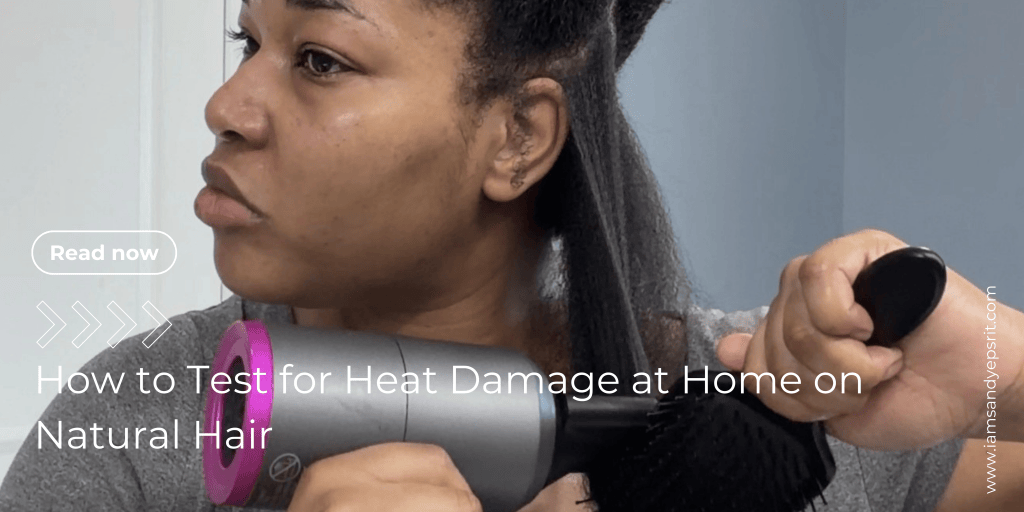
How to Test for Heat Damage at Home on Natural Hair
Have you ever straightened your natural hair, washed it, and noticed that your curls did not bounce back the way they used to? Maybe certain sections look looser, your coils seem to disappear when your hair gets wet, or your hair feels different from before your silk press.
If this sounds familiar, you might be wondering whether you have heat damage.
As someone who has been caring for natural hair for years, I understand how frustrating it can be to work towards healthy hair growth and length retention, only to notice a change in your curl pattern after using heat.
The good news is that you can perform a few simple checks at home to look for signs of heat damage. You do not need expensive tools or a complicated routine to start understanding what is happening with your hair.
However, it is important to know that no single at home test can definitively diagnose heat damage. Dryness, product buildup, chemical treatments, mechanical damage, and the natural differences between sections of your hair can all affect how your curls behave.
In this guide, I will explain how to test for heat damage on natural hair at home, what to look for, and what you can do if you suspect your curls or coils have been affected.
What Is Heat Damage on Natural Hair?
Heat damage occurs when excessive heat alters the structure of the hair shaft. Your hair gets its natural shape from its internal structure, including the bonds that help determine whether individual strands form curls, coils, or waves.
Temporary heat styling can change the shape of your hair, which is why a silk press can give you straight hair that returns to its natural texture after washing.
However, excessive heat or repeated exposure to high temperatures can cause changes that do not reverse after washing. You may notice that some sections remain straighter, curl less, feel rougher, or break more easily.
Heat damage can affect any hair texture, including loose curls, tight curls, and the beautiful range of coils found in type 4 natural hair.
It is also possible to have heat damage in only a few sections. Your ends, crown, front hairline, or the areas where you repeatedly apply heat may behave differently from the rest of your hair.
This is why looking at your entire head of hair is more useful than judging your hair based on one strand.
7 Signs of Heat Damage on Natural Hair
Before performing any tests, look for the following signs.
1. Your curls or coils no longer return after washing
One of the most noticeable signs of possible heat damage is a change in your natural curl pattern.
For example, you might usually have tightly coiled hair, but after washing your hair following a silk press, a particular section remains stretched or almost straight while the surrounding hair curls normally.
Pay attention to whether this is a new change. Natural hair does not always have one uniform curl pattern, and different sections can naturally shrink or curl differently.
A section that has always been looser is not necessarily damaged.
2. Your hair feels unusually dry or rough
Heat can damage the protective outer layer of the hair shaft, contributing to a rough texture and increased difficulty retaining moisture.
Your hair might feel rough even after conditioning, or the ends may feel noticeably different from the roots.
However, dryness alone does not prove heat damage. Hair can also feel dry because of product buildup, harsh cleansing, environmental conditions, or an ineffective conditioning routine.
3. Your hair breaks more easily
If you notice more short broken strands after detangling, styling, or washing, heat damage may be one possible cause.
Damaged hair can become more fragile and prone to breakage.
Try to distinguish breakage from normal shedding. Shed hairs are generally full length and may have a small club shaped bulb at one end. Broken hairs tend to be shorter and vary in length.
Neither observation is a definitive test for heat damage, but it can help you identify a change in your hair’s condition.
4. Your hair has less elasticity
Healthy hair has some ability to stretch and return toward its original shape. Hair that has become significantly weakened may stretch too much, fail to recover, or snap with very little force.
This is sometimes described as poor elasticity.
Do not repeatedly stretch your hair to test it. Excessive pulling can create additional damage, especially when the strands are wet and more vulnerable to mechanical stress.
5. Your hair feels limp or behaves differently when wet
You may notice that certain sections feel unusually soft, limp, or difficult to style after washing.
For example, your hair may not form the same clumps it used to when you apply your usual leave-in conditioner or styling product.
This can happen with heat damage, but it can also result from product buildup, changes in your products, or differences in how you cleanse and condition your hair.
Look for several signs together rather than relying on this one observation.
6. Your ends look thinner or more uneven
Heat damage can contribute to breakage, which may make your ends appear thinner, frayed, or uneven.
If the ends of your hair look much less dense than the roots, pay attention to whether the difference has developed recently.
Other causes include normal wear and tear, tangling, rough detangling, and previous chemical processing.
7. Your hair does not respond to your usual styling routine
Perhaps your wash and go used to produce defined curls, but now certain sections remain stretched or refuse to form the same shape.
Or perhaps your twist outs, braid outs, and other styles look different despite using the same products and techniques.
A change in styling results is worth investigating, especially if it began after repeated heat styling.
Still, product changes, buildup, humidity, and variations in technique can affect the results.
How to Test for Heat Damage at Home on Natural Hair
You can use the following steps to assess your hair without intentionally exposing it to more heat or causing unnecessary breakage.
Test 1: The clean hair curl pattern test
This is one of the most useful starting points if you want to know whether your natural curl pattern has changed.
What you need:
- A gentle shampoo suitable for your scalp and hair.
- Your usual rinse out conditioner.
- Water.
- A mirror and good lighting.
How to do it:
- Divide your hair into manageable sections.
- Cleanse your scalp and hair thoroughly to remove excess product buildup.
- Apply conditioner according to the product instructions and gently detangle using your usual low tension technique.
- Rinse your hair thoroughly.
- Observe how your hair behaves while it is wet, before applying heavy styling products.
- Look at several sections, including the crown, front, sides, back, and ends.
Do your curls and coils return to their usual shape? Are there specific sections that remain unusually straight or stretched?
If certain areas consistently fail to return to their previous pattern, heat damage is one possibility worth considering.
Important: Do not expect every strand to form an identical curl. Your natural texture can vary across your head, and a single wash may not reveal the full picture.
Test 2: Compare the roots, middle lengths, and ends
Your roots may have grown in with your natural texture while your older hair has been exposed to heat styling over time.
This makes comparing different parts of the same section helpful.
Choose a few strands or small sections and observe:
- Roots: Does the new growth appear to have your usual curl or coil pattern?
- Middle lengths: Does the texture gradually change as you move down the strand?
- Ends: Are the ends unusually straight, rough, thin, or prone to tangling?
For example, you might see tightly coiled new growth, a more stretched middle section, and ends that barely curl.
That pattern can be consistent with damage affecting older hair, although it is not proof that heat is the cause.
Other forms of damage can produce similar changes.
Test 3: Compare different sections of your head
Natural hair often has multiple textures. Your crown might behave differently from your nape, and your hairline may have a different curl pattern from the back of your head.
The goal is not to make every section look the same. It is to identify changes from your own normal texture.
Take a few small sections from different areas and observe how they behave after cleansing and conditioning.
Ask yourself:
- Does this section usually curl more tightly?
- Did this change begin after a silk press or another heat styling session?
- Does the same section behave differently every time I wash my hair?
- Are there other signs of damage, such as roughness or breakage?
A section that consistently behaves differently from its previous pattern deserves attention, especially if the change followed heat exposure.
Test 4: Observe your hair’s elasticity gently
You may have heard of the hair elasticity test, where someone stretches a wet strand to see how far it extends before returning to its original shape.
Although elasticity can provide information about the condition of your hair, a simple at home stretch test cannot reliably tell you whether heat is responsible for damage.
If you choose to observe a strand, use a shed hair rather than pulling one from your head.
With a clean, wet shed strand, apply only minimal tension and stop immediately if it starts to stretch excessively or looks as though it may snap.
Do not repeatedly stretch strands to compare them. The results can be influenced by moisture, hair thickness, previous damage, and the condition of the strand.
You do not need to perform this test if your hair is already breaking or fragile.
Test 5: Watch how your hair responds to your normal products
After cleansing and conditioning, use a familiar styling routine that has worked well for your hair in the past.
For example, if you usually wear a wash and go, apply your regular leave-in conditioner and styling product using your normal technique.
Observe whether the sections you suspect are damaged form their usual curls or coils.
If one section consistently remains straighter while the surrounding hair responds normally, this may support your suspicion that the section has undergone a lasting change.
However, do not keep adding products in an attempt to force the curl pattern to return. Heavy product layering can create buildup and make it more difficult to assess your hair.
Test 6: Take comparison photos
Sometimes the changes are subtle enough that you may not notice them immediately.
Photograph your hair in natural or consistent lighting after washing it, using the same general routine each time.
Take pictures of the front, sides, crown, back, and any sections that concern you.
If you have older photos from before your heat styling sessions, compare them with your current hair.
Look for differences in curl formation, density, length, and the appearance of your ends.
Photos can help you identify a pattern over time without repeatedly manipulating your hair.
How to Tell Heat Damage Apart From Dryness
This is where many natural hair routines become confusing.
Dry hair can lose definition, feel rough, tangle more easily, and become difficult to manage. Those symptoms can overlap with heat damage.
The following comparison can help you decide what to investigate next.
| Observation | Possible dryness or buildup | Possible heat damage |
|---|---|---|
| Curl pattern | May improve after cleansing and conditioning | A section may remain permanently altered |
| Hair feel | May improve after adjusting cleansing and conditioning | Roughness may persist in damaged sections |
| Product response | May improve after removing buildup or changing products | Curl changes may persist despite a suitable routine |
| Breakage | Can occur if hair is brittle or handled roughly | Can occur because the hair shaft is weakened |
| Location | May affect much of the hair | May be concentrated in repeatedly heat styled areas |
These are clues, not diagnostic rules. Dryness and heat damage can occur together.
If your curls improve after cleansing and conditioning, that is encouraging, but it does not completely rule out damage. Similarly, curls that fail to return do not automatically prove that heat is responsible.
Can You Reverse Heat Damage on Natural Hair?
The honest answer is that you cannot reliably restore the original curl pattern of hair that has sustained permanent heat damage.
Conditioning treatments, leave-in products, bond-building products, and other hair treatments may improve manageability, reduce friction, and help damaged hair feel smoother. Some products may also improve the appearance and strength of the hair temporarily or to a limited extent.
However, they cannot guarantee that a permanently altered curl pattern will return to its original state.
If your hair has been damaged, your goal should be to protect the hair you have, minimize additional breakage, and support healthy new growth.
1. Pause high heat styling
Give your hair a break from flat irons, hot combs, and repeated high temperature styling while you assess its condition.
If you choose to use heat again later, reduce the frequency, use a suitable heat protectant, and follow the tool manufacturer’s instructions. Avoid repeatedly passing a hot tool over the same section.
Heat protectants can help reduce certain forms of heat related damage, but they do not eliminate the risk.
2. Keep your hair conditioned
Use a conditioner that helps your hair feel manageable and reduces tangling. A suitable leave-in conditioner can also help improve slip during styling.
Focus on gentle detangling, keeping your sections manageable, and avoiding unnecessary tension.
You do not need to purchase an entirely new routine simply because you suspect heat damage.
3. Handle fragile sections gently
Use low tension styles and avoid tight ponytails, aggressive brushing, and repeated manipulation of weakened ends.
If your hair tangles easily, work in sections and detangle slowly rather than forcing a comb through knots.
4. Trim damaged ends when needed
If the ends are persistently splitting, breaking, or tangling, trimming them may help prevent the damaged portions from worsening and make your hair easier to manage.
You do not necessarily have to cut off all your hair or make a dramatic decision immediately.
You can gradually trim damaged ends as you monitor your hair, or seek advice from a stylist experienced with textured hair if the damage is extensive.
5. Give new growth time
Hair grows from the scalp, so new growth can emerge with your usual natural texture even if older lengths remain damaged.
Length retention depends on both growth and how much of your existing hair you can preserve.
Focus on a consistent routine, gentle handling, scalp care, and minimizing additional damage rather than trying to force your curls to return overnight.
When Should You Seek Professional Advice?
Consider consulting a dermatologist or qualified hair care professional if you notice sudden or unexplained hair loss, bald patches, scalp pain, significant breakage near the roots, or persistent scalp irritation.
Those symptoms may have causes unrelated to heat damage and should not automatically be attributed to styling.
If you are unsure whether the changes in your hair are caused by heat, chemical processing, or another issue, a professional assessment may help you determine the next steps.
Frequently Asked Questions About Heat Damage on Natural Hair
How do I know if my 4C hair has heat damage?
Look for sections that no longer return to their usual coil pattern after washing, particularly if the change began after heat styling. Also observe whether the hair feels different, breaks more easily, or has uneven ends. Your 4C hair may naturally have different coil patterns in different areas, so compare your current hair with your own previous texture.
Can heat damage happen after one silk press?
Yes. Heat damage can occur after a single heat styling session if the temperature, technique, or exposure is sufficiently damaging. However, not every silk press causes damage. Risk depends on factors such as the condition of the hair, temperature, technique, and repeated exposure.
Can deep conditioning reverse heat damage?
Deep conditioning can improve softness, slip, and manageability. It cannot guarantee that permanently altered hair will return to its original curl pattern. If you suspect heat damage, focus on conditioning, gentle handling, and preventing additional damage.
Will my natural curl pattern ever come back?
If the hair shaft has been permanently altered, the original pattern may not return in that section. New growth can emerge with your natural texture, while the damaged lengths remain different until they are trimmed away.
Should I cut off all my heat damaged hair?
Not necessarily. Your decision depends on the extent of the damage, how much breakage you are experiencing, and your personal hair goals. You can trim gradually if that suits you, or choose a larger cut if you prefer to remove the damaged lengths sooner.
Does heat damage stop natural hair from growing?
Heat damage usually affects the hair shaft rather than stopping growth from the follicle. However, breakage can make it difficult to retain length, giving the impression that your hair is not growing. Sudden or significant hair loss should be assessed separately.
Final Thoughts: Pay Attention to What Your Hair Is Telling You
Learning how to test for heat damage at home on natural hair starts with observing your hair rather than immediately assuming the worst.
Cleanse and condition your hair, compare different sections, pay attention to your curl pattern, and monitor changes in texture and breakage. If you suspect damage, give your hair a break from high heat and focus on gentle, consistent care.
Remember that natural hair does not have to look identical from root to tip or from one section to another. Your goal is not perfection. It is understanding your hair well enough to care for it.
And if you have heat damage, do not panic. You can still care for your hair, protect the new growth, and work towards your length retention goals.
I try it. I finish it. I tell you if it’s worth your money. When it comes to natural hair, that also means being honest about what products can do, what they cannot do, and when your hair simply needs time and gentler handling.


Leave a Reply