If you love wearing your natural hair out but constantly feel like you’re losing progress because of breakage, you’re not alone.
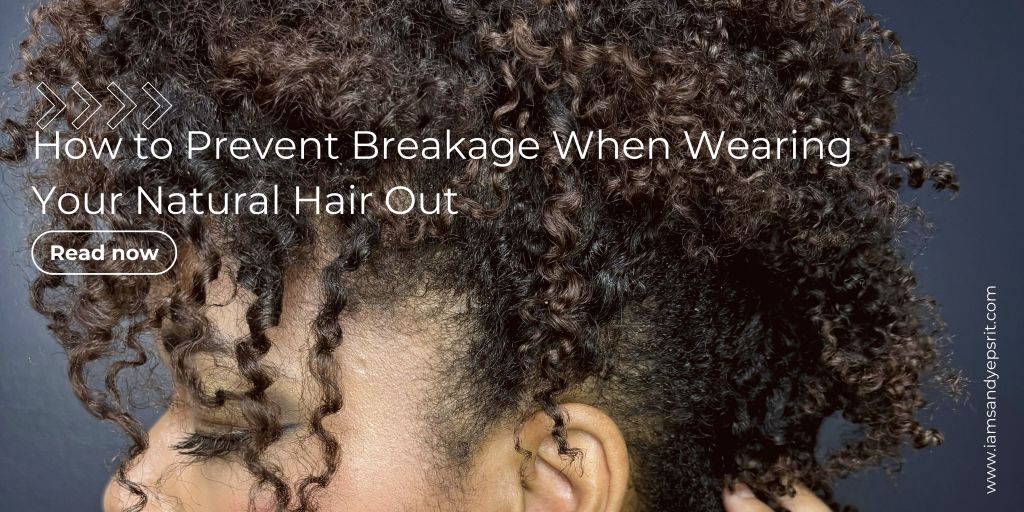
One of the biggest misconceptions about natural hair is that wearing it out automatically causes damage. It doesn’t. Natural hair can absolutely be worn out and still retain length. The problem is usually what happens to the hair while it’s being worn out: excessive manipulation, dryness, friction, tangling, rough detangling, and styling techniques that put unnecessary stress on the strands.
If your goal is longer, fuller, healthier natural hair, you don’t have to keep your hair in protective styles 24/7. You can wear your curls, coils, wash-and-gos, twist-outs, braid-outs, puffs, and stretched styles while still prioritizing length retention.
The key is learning how to make wearing your natural hair out lower manipulation rather than higher manipulation.
In this guide, I’m sharing how to prevent breakage when wearing your natural hair out, including how to moisturize natural hair, reduce tangles, protect your ends, detangle without excessive shedding, sleep with your hair out, and create a routine that supports length retention.
What Causes Breakage When Wearing Natural Hair Out?
Before talking about prevention, it helps to understand why breakage happens.
Breakage occurs when the hair strand physically snaps. This is different from shedding, which is when a naturally shed hair falls from the follicle.
When you’re wearing your natural hair out, several things can contribute to breakage:
- Frequent manipulation
- Dryness and brittleness
- Excessive detangling
- Rough brushing or combing
- Tight hairstyles
- Friction from clothing
- Friction from cotton pillowcases
- Constantly touching or fluffing the hair
- Picking at knots
- Excessive heat
- Chemical processing
- Neglecting the ends
- Wearing the same hairstyle repeatedly
- Not properly moisturizing the hair
- Sleeping without protecting the hair
And sometimes, it’s not one thing.
It’s the cumulative effect of small amounts of stress happening over and over again.
You might not notice one rough detangling session. But if you’re aggressively detangling your hair every few days, constantly manipulating it throughout the week, and sleeping with it loose against cotton sheets every night, that repeated stress can eventually show up as breakage.
1. Don’t Be Afraid to Wear Your Natural Hair Out
Let’s start here because I think natural hair has sometimes been presented as something that needs to be hidden away in order to thrive.
You don’t have to keep your hair in braids, wigs, or other protective styles all the time to retain length.
Wearing your natural hair out isn’t inherently damaging.
In fact, one of the best things you can do is learn how to wear your hair out with less manipulation.
Think about the difference between:
“My hair is out, so I need to style it every morning.”
and:
“My hair is out, and I’m going to leave it alone as much as possible.”
Those are two completely different routines.
A wash-and-go that you refresh every morning, constantly separate, fluff, pick, and manipulate may create more mechanical stress than a wash-and-go that you allow to evolve over several days.
Your goal doesn’t have to be perfect hair every single day.
Sometimes leaving your hair alone is the length-retention strategy.
2. Keep Your Hair Properly Conditioned
Dry hair tends to feel rough, stiff, and more difficult to manipulate.
That doesn’t mean you need to constantly coat your hair with oils or heavy products.
Instead, focus on building a consistent wash-day routine that leaves your hair conditioned and manageable.
A good natural hair routine can include:
- Cleansing the scalp and hair.
- Conditioning regularly.
- Detangling while the hair has plenty of slip.
- Applying appropriate styling products.
- Limiting unnecessary manipulation between wash days.
Conditioner is especially important when you’re trying to reduce breakage because it can make the hair easier to detangle and manage.
Look for conditioners that give your hair enough slip that you’re not fighting through knots.
And remember: moisture isn’t just about adding water or applying an oil.
Healthy-looking, manageable hair comes from an overall routine that includes cleansing, conditioning, hydration, and appropriate styling.
3. Detangle Your Hair Gently
If you’re wearing your natural hair out, eventually you’re going to have to detangle it.
And this is where a lot of unnecessary breakage can happen.
Instead of attacking your hair with a brush or comb, make detangling a process.
Start by dividing your hair into manageable sections.
Apply conditioner or another product that provides slip, then gently work through the ends before moving toward the roots.
If you encounter a knot, don’t immediately pull through it.
Use your fingers to gently separate the hairs around the knot.
This may take longer, but the goal isn’t to get the job done as quickly as possible.
The goal is to remove tangles without unnecessarily breaking the hair.
Your detangling technique matters just as much as the tools you use.
4. Stop Trying to Make Your Hair Perfect Every Day
This one is probably more important than it sounds.
Natural hair changes throughout the week.
Your wash-and-go may look completely different on day one compared with day four.
Your twist-out may become bigger.
Your curls may lose definition.
Your hair may frizz.
And that’s okay.
One of the easiest ways to increase manipulation is constantly trying to recreate day-one hair.
You wake up, look in the mirror, and think:
“Let me fix this.”
Then you separate it.
You fluff it.
You add product.
You pick it.
You reshape it.
You brush the edges.
You repeat.
And suddenly you’ve manipulated your hair several times before breakfast.
Instead, ask yourself:
Does my hair actually need to be fixed, or does it just look different today?
Sometimes embracing the evolution of your style is one of the simplest ways to reduce breakage.
5. Protect Your Ends
If you’re trying to retain length, your ends deserve special attention.
Your ends are the oldest part of your hair, which means they’ve been exposed to the environment and manipulation longer than the hair closer to your scalp.
When wearing your natural hair out, your ends can rub against:
- Your shoulders
- Sweaters
- Coats
- Scarves
- Car seats
- Backpacks
- Bedding
- Cotton clothing
That constant friction can contribute to mechanical damage.
You don’t necessarily have to hide your ends every day.
But you can reduce unnecessary friction.
For example, if you’re wearing a rough sweater, consider a hairstyle that keeps your ends from constantly rubbing against the fabric.
You can also periodically incorporate lower-manipulation styles that tuck or gather the ends when they need a break.
6. Be Careful With Tight Ponytails and Puffs
Puffs and ponytails are convenient, but convenience doesn’t automatically equal low manipulation.
Pulling your hair tightly into the same style repeatedly can place stress on the hair.
Instead of creating the tightest possible puff, aim for a comfortable style with enough hold to stay in place without excessive tension.
And don’t assume that because your hair is natural, it can tolerate unlimited tension.
Your curls and coils still need gentle handling.
If a style hurts, feels excessively tight, or leaves your scalp uncomfortable, that’s a sign to reconsider the technique.
7. Reduce Friction While You Sleep
You can spend an entire day being gentle with your hair and then undo some of that work overnight.
If you’re sleeping with your hair loose against a cotton pillowcase, your curls can rub against the fabric for hours.
A satin or silk pillowcase can help reduce friction, while a satin or silk bonnet can provide another layer of protection.
You can also loosely gather your hair before bed rather than sleeping with it completely loose.
The goal isn’t to create an elaborate nighttime routine.
It’s simply to reduce unnecessary friction while you’re sleeping.
8. Don’t Over-Manipulate Your Hair Between Wash Days
Your hands can be one of the biggest sources of manipulation.
If you’re constantly touching, separating, fluffing, twisting, or picking at your curls, you’re repeatedly putting mechanical stress on the hair.
This is especially easy to do when you love the way your natural hair feels.
But if length retention is your goal, consider adopting a simple rule:
Style your hair, then leave it alone.
You don’t need to constantly rearrange your curls.
You don’t need to separate every curl that clumps together.
You don’t need to fix every frizzy section.
And you definitely don’t need to pick your hair repeatedly just to make it bigger.
Sometimes the best thing you can do for your hair is nothing.
9. Be Strategic With Heat
Wearing your natural hair out doesn’t mean you can’t use heat.
Blowouts, stretched styles, silk presses, and other heat-styled looks can absolutely be part of a natural hair routine.
The key is being intentional.
If you’re using heat:
- Use an appropriate heat protectant.
- Avoid unnecessarily high temperatures.
- Keep the tool moving.
- Minimize repeated passes.
- Avoid applying heat to excessively wet hair.
- Give your hair time between intensive heat-styling sessions.
- Pay attention to changes in your curl pattern and hair condition.
And here’s something I think is important:
You don’t always need to make your hair bone straight.
If you’re using a blow dryer to stretch your hair before braiding or styling, you may only need enough heat to elongate the hair.
You don’t need to chase perfectly straight strands if that’s not the goal.
Less heat and fewer passes can mean less opportunity for unnecessary damage.
10. Don’t Ignore Your Scalp
Healthy hair care isn’t only about what happens to the ends.
Your scalp is the foundation from which your hair grows, so keeping your scalp clean and comfortable is an important part of your routine.
You don’t necessarily need a complicated scalp-care regimen.
Focus on regular cleansing and pay attention to buildup, excessive oil, irritation, or other changes.
And remember: piling product onto your scalp isn’t the same thing as moisturizing your hair.
Use products intentionally rather than continuously layering them on because you think more product equals healthier hair.
11. Alternate Your Hairstyles
If you always wear your hair the exact same way, you’re repeatedly stressing the same areas.
For example, if you always wear a slicked-back ponytail in the exact same position, you’re putting repeated tension and manipulation in the same location.
Instead, vary your hairstyles.
You might alternate between:
- Wash-and-gos
- Twist-outs
- Braid-outs
- Loose puffs
- Stretched styles
- Low-manipulation updos
- Loose buns
- Defined curls
The goal isn’t to constantly style your hair.
It’s to avoid repeatedly stressing the same strands in the same way.
12. Don’t Confuse Shedding With Breakage
This is something every natural should understand.
Finding hair in your comb or shower doesn’t automatically mean your hair is breaking.
Hair naturally sheds as part of its growth cycle.
Shed hairs are generally longer strands with a small bulb at one end.
Broken hairs tend to be shorter pieces without that root bulb.
Understanding the difference can help you figure out what’s actually happening with your hair.
If you’re seeing lots of short broken pieces, noticing thinning areas, or experiencing significant changes in your hair, it’s worth taking a closer look at your routine and, when appropriate, speaking with a qualified healthcare professional or dermatologist.
13. Trim When Your Ends Need It
There’s a lot of anxiety around trimming natural hair because so many people are focused on length.
But retaining length isn’t simply about never cutting your hair.
It’s about keeping the length you grow.
If your ends are severely split, tangled, or damaged, holding onto every last millimeter may actually make your hair harder to manage.
Regular trims can help you maintain healthier-looking ends.
How often you need a trim depends on your hair, styling habits, heat use, chemical treatments, and the condition of your ends.
Instead of blindly following a calendar, learn to assess your hair.
If your ends are constantly tangling, look thin and ragged, or have significant splitting, it may be time for a trim.
14. Choose Low-Manipulation Styling Over Constant Restyling
Here’s the biggest theme running through all of this:
Your hair doesn’t need to be manipulated constantly to look good.
A low-manipulation style is one that allows your hair to remain relatively undisturbed for several days.
That might mean defining your curls on wash day and leaving them alone.
It might mean doing a twist-out and wearing it until your next wash.
It might mean stretching your hair once and styling it without repeatedly restyling it.
The fewer times you’re physically manipulating each strand, the fewer opportunities you’re creating for mechanical breakage.
15. Focus on Length Retention, Not Just Hair Growth
Your hair may already be growing at a perfectly normal rate.
The problem may be that you’re breaking off the length you’re growing.
That’s why length retention is such an important part of natural hair care.
Think about it this way:
Growth happens at the scalp. Retention happens at the ends.
You can have healthy hair growth but struggle to see length if your ends are constantly breaking.
Instead of constantly searching for products that promise faster growth, start asking:
- How often am I manipulating my hair?
- Am I detangling gently?
- Are my ends protected from excessive friction?
- Am I using too much heat?
- Am I constantly restyling?
- Am I sleeping with my hair protected?
- Are my hairstyles too tight?
- Is my hair properly conditioned?
Those questions may tell you much more about your length-retention journey than another growth oil ever will.
A Simple Natural Hair Breakage Prevention Routine
You don’t need a 25-step routine to reduce breakage.
Here’s a simple framework you can actually maintain.
Wash Day
1. Cleanse your scalp and hair.
Remove buildup and keep your scalp clean.
2. Condition thoroughly.
Choose a conditioner that gives your hair enough slip for easy detangling.
3. Detangle gently.
Work in sections and start at the ends.
4. Apply your styling products.
Use products that give you the moisture, definition, or hold you need.
5. Choose a low-manipulation style.
Once your hair is styled, leave it alone.
During the Week
- Avoid unnecessary touching.
- Don’t constantly restyle your curls.
- Protect your hair from excessive friction.
- Keep your ends in mind.
- Avoid excessively tight hairstyles.
- Refresh only when necessary.
At Night
- Use a satin or silk bonnet or pillowcase.
- Loosely gather longer hair if necessary.
- Avoid sleeping with wet hair if it causes excessive tangling or manipulation the next morning.
The Bottom Line: You Don’t Have to Hide Your Natural Hair to Retain Length
If you take nothing else from this article, let it be this:
You do not have to stop wearing your natural hair out to prevent breakage.
You need to learn how to wear it out with less manipulation.
Natural hair doesn’t need to be constantly protected from the world. It needs to be handled intentionally.
Wash it.
Condition it.
Detangle it gently.
Style it.
Protect it while you sleep.
Give your ends some attention.
And then leave it alone.
You don’t need to chase perfect curls every day.
You don’t need to constantly manipulate your hair.
You don’t need to put your hair away for months at a time just to retain length.
Sometimes the biggest shift in your natural hair journey is realizing that healthy hair care isn’t about doing more. It’s about doing less—but doing it better.
And when your goal is length retention, that’s a lesson worth remembering:
The less unnecessary manipulation you put your hair through, the more opportunity you give your hair to keep the length you’re already growing.
Frequently Asked Questions
How can I wear my natural hair out without it breaking?
Focus on minimizing manipulation, keeping your hair conditioned, detangling gently, protecting your ends from excessive friction, avoiding overly tight hairstyles, and protecting your hair while you sleep.
Does wearing natural hair out cause breakage?
Not necessarily. Wearing your natural hair out isn’t inherently damaging. Breakage is more likely when the hair is repeatedly subjected to excessive manipulation, friction, tension, dryness, heat, or rough handling.
How do I prevent breakage in my natural hair?
A consistent cleansing and conditioning routine, gentle detangling, reduced manipulation, appropriate heat use, protecting the ends, and nighttime protection can all help reduce mechanical stress on the hair.
Is it better to wear natural hair in protective styles?
Protective styles can reduce daily manipulation, but they aren’t automatically healthier than wearing your natural hair out. A poorly installed or excessively tight protective style can cause its own problems. The best hairstyle is one that allows you to manage your hair without excessive tension or manipulation.
How often should I moisturize my natural hair?
There isn’t one universal schedule that works for everyone. Pay attention to how your hair feels and how quickly it becomes dry. Your wash-day conditioning routine and styling products may provide enough moisture for several days, while some hair may need additional hydration between washes.
How do I retain length with natural hair?
Length retention comes down to preventing the hair you’re growing from breaking off. Minimize unnecessary manipulation, take care of your ends, detangle gently, reduce excessive heat and friction, and maintain a consistent hair-care routine.
SEO Keywords
Primary keyword: how to prevent breakage when wearing natural hair out
Secondary keywords: natural hair breakage, prevent natural hair breakage, how to stop natural hair breakage, natural hair length retention, how to retain length natural hair, healthy natural hair, natural hair care routine, how to protect natural hair, natural hair out, reduce breakage natural hair, prevent breakage natural hair, natural hair tips, how to grow natural hair longer, natural hair maintenance, low manipulation natural hair


Leave a Reply