If you have 4B or 4C natural hair, you probably already know that hair growth and length retention are not the same thing.
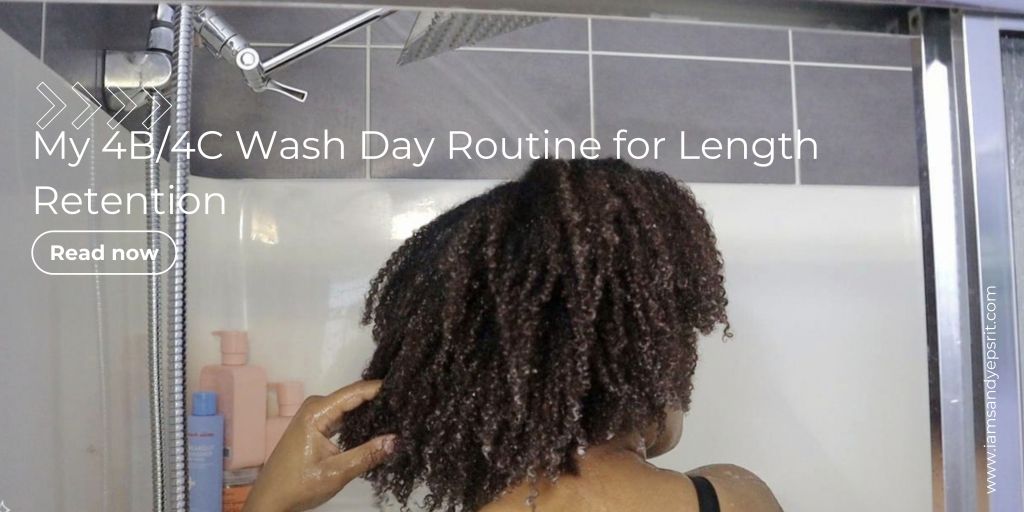
My hair grows. The challenge has been keeping the length I grow.
After years of wearing my natural hair, learning what my strands like, dealing with heat damage, and becoming much more intentional about how I handle my hair, my wash day routine has changed.
I’m no longer interested in doing the most just because something is trending.
I’m interested in reducing breakage, minimizing mechanical damage, keeping my hair moisturized, making detangling easier, and protecting my ends so I can actually retain length.
And yes, products matter.
But I don’t think you need to spend a fortune on every step of your wash day either.
Some of the products I use are relatively affordable, while others are definitely more of a splurge. I’ll tell you which ones I think are worth it, where you can save money, and what I actually notice when I use them on my 4B/4C hair.
What Does Length Retention Mean for 4B/4C Hair?
Before we get into my routine, let’s talk about what we’re actually trying to accomplish.
Your hair grows from your scalp. Length retention is about keeping that new growth instead of losing it to breakage.
So if your hair is growing at the roots but breaking at the ends, you may feel like your hair isn’t growing.
For me, length retention comes down to reducing the things that can cause unnecessary damage:
- Excessive manipulation
- Aggressive detangling
- Dryness
- Mechanical damage
- Heat damage
- Split ends
- Excessive tension
- Constant styling and restyling
That’s why my wash day isn’t simply about getting my hair clean.
I’m thinking about what happens to my hair during every step of the process.
Step 1: Detangling My 4B/4C Hair
One of the biggest things I’ve changed about my wash day is how I detangle.
If you have tightly coiled hair, you know that detangling can either be a relatively smooth process or feel like you’re preparing for battle.
I’m not trying to win a battle with my hair.
I’m trying to get through wash day with as little unnecessary breakage as possible.
That’s why I pay attention to mechanical damage.
Mechanical damage is essentially physical damage caused by manipulation, such as pulling, tugging, brushing, combing, or aggressively working through knots.
And because detangling is one of the most mechanically demanding parts of my wash day, I want tools that make the process easier.
My Budget-Friendly Detangling Option: Unbrush
One of my favorite tools for making detangling easier is the Unbrush.
What I love about it is the flexible bristles.
They make it much easier for me to work through my 4B/4C hair without feeling like I’m fighting every single tangle.
The flexibility is important to me because I’m not looking for a brush that is going to aggressively pull through my hair.
I’m looking for something that can move through the hair while helping me reduce unnecessary mechanical damage.
And honestly, this is one of those products where the difference is noticeable.
The easier detangling becomes, the less tempted I am to rush through it.
That’s a win for length retention.
Another Option: Tangle Teezer
Another detangling tool I use is the Tangle Teezer.
It also makes detangling much easier and helps reduce the amount of mechanical damage I experience during the process.
The biggest difference I notice between the two is the bristles.
The Tangle Teezer’s bristles are closer together, while I find the Unbrush’s flexible design particularly easy to work through my hair.
Both can make a big difference compared with trying to force a regular brush through tightly coiled hair.
My Take
If you’re trying to build a 4B/4C wash day routine for length retention, I would prioritize finding a detangling tool that allows you to work through your hair without excessive pulling.
You don’t necessarily need both.
If you already have a detangling tool that works well for you, use it.
The goal isn’t to own the most popular brush.
The goal is less fighting with your hair.
Step 2: Shampooing My 4B/4C Hair
Once I’ve detangled my hair, I move on to cleansing.
I don’t believe natural hair should be afraid of shampoo.
Your scalp needs to be cleansed, especially if you’re using multiple styling products or going several days between wash days.
The key for me is finding a shampoo that cleanses without leaving my hair feeling stripped.
My SheaMoisture Bond Repair Shampoo
One of the shampoos I’ve been using is the SheaMoisture Amla Oil Bond Repair Shampoo.
SheaMoisture Amla Oil Bond Repair Shampoo
I really like this one because it gives me that balance I’m looking for.
It cleanses nicely, but my hair doesn’t feel like I’ve completely removed everything from it.
It’s also moisturizing, and I’m not going to lie: it smells really good.
And when you’re washing your hair regularly, enjoying the products you’re using matters.
I’m much more likely to look forward to wash day when the products actually feel good to use.
For someone looking for a more budget-conscious option for their natural hair routine, this is one I’d consider.
Step 3: Conditioning for Slip
After shampooing, I condition.
For me, conditioner isn’t just about making my hair feel soft.
Slip matters.
The easier it is to separate my hair, the less I have to pull and manipulate it.
SheaMoisture Bond Repair Conditioner
I pair the shampoo with the SheaMoisture Bond Repair Conditioner.
SheaMoisture Bond Repair Conditioner
I like the slip, and it doesn’t feel heavy on my hair.
It also smells good, which is another little bonus.
My one criticism?
I find it a little too lightweight.
If your hair loves lightweight products, that may actually be exactly what you want.
But when I’m looking for that rich, deeply conditioned feeling, this isn’t necessarily the product I reach for first.
And this is where I think it’s important to be honest about products.
A product can be good and still not be perfect for your particular hair.
Step 4: When My Hair Needs More Than Conditioner
Sometimes my hair needs more.
Especially when I’m dealing with hair that has experienced damage, I don’t necessarily want to stop at shampoo and conditioner.
This is where some of my more expensive treatments come into play.
Olaplex No. 3 Hair Perfector
One product I use when my hair needs some extra attention is Olaplex No. 3.
I find it particularly useful when my hair has experienced some damage and needs a little more care.
But here’s something important:
I don’t think this is an every-wash product.
More product doesn’t automatically mean better results.
I use treatments like this strategically rather than assuming I need to use them constantly.
If your hair is relatively healthy and you’re simply looking for a basic weekly wash day, you may not need to spend extra money on a treatment like this every single time.
That’s where knowing what your hair actually needs becomes more important than following a viral routine.
Step 5: My Splurge Treatment
If we’re talking about a product that makes me notice a difference immediately, there’s another one that deserves a mention.
Love Ur Curls Hydrating Bond Repair Hair Mask
The Love Ur Curls Hydrating Bond Repair Hair Mask is one of those products where I feel the difference in my hair right away.
Love Ur Curls Hydrating Bond Repair Hair Mask
My hair feels completely different after using it.
It gives amazing slip, my hair feels softer, and it smells good.
And that slip is important because it makes the next stage of handling my hair much easier.
This is one of the products I’d put into the “worth considering if you’re willing to spend a little more” category.
It’s not something I would tell everyone they absolutely need.
But if you’re dealing with hair that needs extra conditioning and you want something that gives you that immediate “oh, my hair feels different” experience, this is one I’d look at.
Step 6: Olaplex Bond Maintenance Shampoo and Conditioner
Another option I have in my rotation is the Olaplex Hydrating Curls Shampoo and Conditioner.
Olaplex Hydrating Curls Shampoo and Conditioner
I really like this combination for curly hair that needs that extra level of care.
This is definitely more of a splurge option compared with the SheaMoisture products.
And this is where I’m going to tell you something I think is important when shopping for natural hair products:
You don’t necessarily need to upgrade every product in your routine.
You can have a budget-friendly shampoo and spend more on your treatment.
You can use an affordable conditioner and splurge on your detangling tool.
You can mix and match.
Your entire wash day doesn’t have to be luxury for your hair to be cared for properly.
Step 7: A Treatment That Makes My Hair Easier to Detangle
Another product I’ve tried that stands out for me is the L’Oréal Professionnel Absolut Repair Molecular.
L’Oréal Professionnel Absolut Repair Molecular
This one is just amazing to me.
My hair feels softer and easier to detangle.
And again, we’re back to that same theme:
If a product makes my hair easier to manipulate, that’s important to me when I’m thinking about length retention.
Because the less I have to fight with my hair, the less mechanical stress I’m putting on it.
This is definitely another product I’d put into the pricier category, but it’s one of the products where I notice the difference in how my hair feels.
Step 8: Sealing and Adding Shine
After I’ve washed and treated my hair, I want to make sure I’m not just leaving my hair feeling soft for five minutes.
I want to maintain that softness and prepare my hair for styling.
Olaplex No. 7 Bonding Oil
One product I really like for this is Olaplex No. 7 Bonding Oil.
What I like about it is that it’s lightweight.
It doesn’t leave my hair feeling weighed down, but it gives me that nice sealed feeling and adds shine.
If you’re someone who doesn’t like heavy oils sitting on your hair, this is the type of oil I’d consider.
Again, though, you don’t have to use an expensive oil just because it’s expensive.
If you already have an oil that works for your hair and doesn’t leave it greasy or weighed down, keep using it.
Step 9: Heat Protection Is Part of My Length-Retention Routine
This is especially important for me because I’ve experienced heat damage.
I use heat, but I’ve become much more intentional about it.
For me, heat protection isn’t optional when I’m going to use heat.
I’m not trying to get my hair bone straight at the highest temperature possible.
I’m usually trying to stretch my 4B/4C hair while minimizing unnecessary heat exposure and tension.
I also don’t believe that “natural hair” means you can never use a blow dryer.
It means understanding how you’re using it.
The combination of excessive heat, repeated heat exposure, and tension is what I want to be careful about.
My goal is simple:
Use the least amount of heat and manipulation necessary to get the result I want.
My Budget-Friendly vs. Splurge Wash Day
If you’re looking at all these products and thinking, “Sandy, I’m not buying all of that,” don’t.
Seriously.
You don’t need to.
If I were building a routine while trying to keep the cost down, I’d focus on the fundamentals first.
Budget-Friendly Foundation
Start with:
Detangling tool:
Unbrush
Shampoo:
SheaMoisture Amla Oil Bond Repair Shampoo
Conditioner:
SheaMoisture Bond Repair Conditioner
You can absolutely build a functional wash day around those basics.
Where I Would Consider Spending More
If you have room in your budget, I’d look at adding a treatment or mask that addresses what your hair actually needs.
Some of my more premium options include:
Love Ur Curls Hydrating Bond Repair Hair Mask
L’Oréal Professionnel Absolut Repair Molecular
And if you want a lightweight finishing oil:
My 4B/4C Wash Day Routine for Length Retention: The Short Version
If you don’t want to read my entire wash day routine every time you wash your hair, here’s the simple version:
1. Detangle carefully.
Use a tool that minimizes pulling and makes it easier to work through your hair.
2. Cleanse your scalp.
Don’t be afraid of shampoo. A clean scalp is part of a healthy hair routine.
3. Condition for slip.
Choose a conditioner that makes your hair easier to manipulate.
4. Add a treatment when your hair needs it.
You don’t necessarily need a bond-repair treatment every wash day.
5. Handle your hair gently.
Less pulling, tugging, and unnecessary manipulation can help reduce breakage.
6. Protect your hair when using heat.
Heat can be part of your routine without being the enemy, but you have to be intentional.
7. Pay attention to your ends.
Your ends are the oldest part of your hair, so don’t treat them like they’re indestructible.
8. Keep manipulation low after wash day.
Sometimes the best thing you can do for your hair is leave it alone.
The Biggest Lesson I’ve Learned About Length Retention
The biggest thing I’ve learned is that I don’t need a miracle product.
I need to stop losing the length I’m already growing.
That’s a completely different mindset.
I’m not looking at my hair thinking, “What can I put on my scalp to make it grow faster?”
I’m asking:
“What can I do differently so that the hair I’m growing actually stays on my head?”
For me, that means making detangling easier.
It means paying attention to mechanical damage.
It means keeping my hair conditioned.
It means using treatments when my hair actually needs them.
It means protecting my hair when I use heat.
And it means not automatically spending more money just because a product is more expensive.
Some products are worth the splurge for me.
Some aren’t.
And that’s exactly why I like trying products myself before telling you to spend your money on them.
Because you don’t need another person online telling you that everything is amazing.
You need someone to tell you what actually made a difference.
Final Thoughts
My 4B/4C wash day routine has evolved quite a bit over the years.
What I’m focused on now is simple: healthy hair, less breakage, easier detangling, and length retention.
I don’t believe there’s one perfect routine for every person with 4B or 4C hair.
Your hair may need something completely different from mine.
But if you’re struggling with length retention, start by looking at the way you’re handling your hair.
Look at your detangling.
Look at your ends.
Look at how much heat and tension you’re using.
Look at whether your hair is actually getting enough conditioning.
And then look at your products.
You don’t have to buy everything I’ve mentioned in this post.
Start with what solves the biggest problem you’re currently having.
For me, making detangling easier and reducing mechanical damage has been a big part of changing how I approach wash day.
Because at the end of the day, I’m not trying to have hair that simply grows.
I’m trying to have hair that grows and stays.
Grow it. Protect it. Retain it.
Shop My 4B/4C Wash Day
Detangling
Cleansing & Conditioning
- SheaMoisture Amla Oil Bond Repair Shampoo
- SheaMoisture Bond Repair Conditioner
- Olaplex Hydrating Curls Shampoo & Conditioner
Treatments
- Olaplex No. 3
- Love Ur Curls Hydrating Bond Repair Hair Mask
- L’Oréal Professionnel Absolut Repair Molecular
Finishing
Some links in this post are affiliate links, which means I may earn a commission if you purchase through them, at no additional cost to you. I only recommend products I’ve actually used and can speak to from my own experience.
How often should you wash 4B/4C hair for length retention?
There isn’t one wash schedule that works for everyone with 4B or 4C hair. I focus on keeping my scalp clean and my hair conditioned while avoiding unnecessary manipulation. Your wash frequency can depend on your scalp, lifestyle, styling routine, and how your hair responds to washing.
What is the best wash day routine for 4B/4C hair?
A good 4B/4C wash day routine can include gentle detangling, cleansing the scalp, conditioning, using a treatment when needed, moisturizing, and minimizing manipulation. For me, making detangling easier and reducing mechanical damage are important parts of my length-retention routine.
How do you retain length with 4B/4C natural hair?
For me, length retention comes down to reducing breakage and unnecessary manipulation. I focus on gentle detangling, keeping my hair conditioned, protecting my ends, being intentional with heat, and choosing styles that don’t require constant manipulation.
What products help with length retention for 4B/4C hair?
The products that help me most are the ones that make my hair easier to handle and reduce unnecessary manipulation. My routine includes detangling tools such as the Unbrush and Tangle Teezer, SheaMoisture shampoo and conditioner, and treatments such as Olaplex No. 3, Love Ur Curls Hydrating Bond Repair Hair Mask, and L’Oréal Professionnel Absolut Repair Molecular.
Is detangling 4C hair causing breakage?
It can if the hair is being pulled, tugged, or brushed through aggressively. That’s why I pay close attention to how I detangle my 4B/4C hair. I use tools with flexible or appropriately spaced bristles, work through sections, and focus on making the process easier rather than rushing through it.
Can you use heat on 4B/4C hair and still retain length?
Yes, but heat needs to be used intentionally. I have experienced heat damage, so I am much more conscious about heat protection, temperature, tension, and how frequently I’m using heat. My goal is to stretch or style my hair without exposing it to more heat or manipulation than necessary.
Do you need expensive products to retain length with 4B/4C hair?
No. You don’t need an expensive product for every step of your wash day. I use both budget-friendly and higher-priced products in my routine. I would rather spend more on a product when I can clearly feel or see a difference and save money where a less expensive product does the job well.


Leave a Reply