If your natural hair seems to be growing, but your length never seems to change, you are probably dealing with a length retention problem—not a hair growth problem.
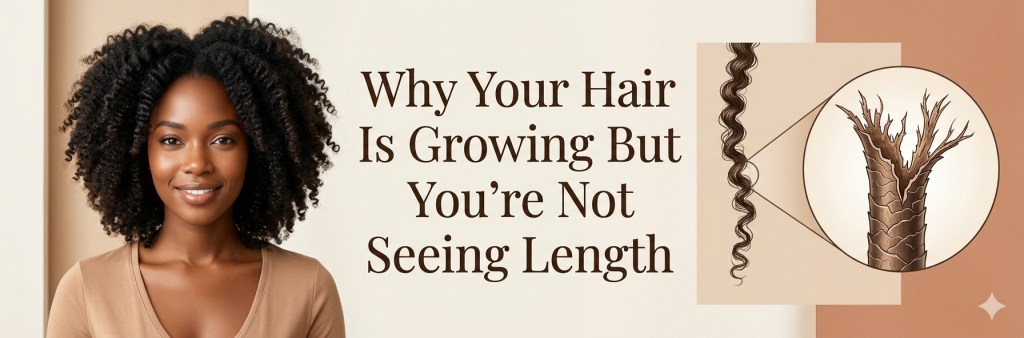
This is one of the most frustrating parts of growing natural hair. You can look at your roots and see new growth. Your hair is getting longer underneath. But when you stretch it, straighten it, or compare it to an old photo, it feels like you’re stuck at the same length.
So what is actually happening?
In most cases, your hair is growing, but you are losing some or all of that new length through breakage, split ends, excessive manipulation, dryness, tangling, heat damage, or styling practices that put too much stress on the hair.
And if you have type 4 hair, especially 4B or 4C hair, this can be even more noticeable because tightly coiled hair naturally experiences more shrinkage and can be more difficult to retain length without consistent care.
Let’s break down why your hair can grow without you seeing the length—and what you can actually do about it.
Hair Growth vs. Length Retention: They’re Not the Same Thing
First, let’s clear up the biggest misconception.
Hair growth and length retention are two different things.
Hair growth happens at the scalp. Your hair follicles produce new hair, and that hair gradually pushes out from the scalp.
Length retention happens at the ends.
You need to retain enough of the hair that you grow for your overall length to increase.
Think of it this way:
Your scalp grows the hair. Your routine determines how much of that hair you keep.
If your hair grows about half an inch per month but you consistently break off a similar amount from your ends, you may not see much change in your overall length.
This is why someone can have healthy-looking new growth at the roots while feeling like their hair “isn’t growing.”
It probably is.
You just aren’t retaining all of it.
1. Your Hair May Be Growing, But Your Ends Are Breaking
One of the biggest reasons you don’t see length is breakage.
Breakage occurs when the hair shaft snaps somewhere along its length. Unlike shedding, the hair is not coming out from the root.
You may notice:
- Short pieces of hair on your clothes
- Broken hairs in your sink
- Lots of small pieces after detangling
- Uneven ends
- Shorter pieces around your crown or hairline
- Your hair becoming thinner toward the ends
- Difficulty getting your hair to grow past a certain length
If your hair is constantly breaking at approximately the same rate that it grows, your overall length may appear stagnant.
And this can happen even when your scalp is completely healthy.
What causes breakage?
Common causes include:
- Excessive manipulation
- Rough detangling
- Dry or brittle hair
- Frequent heat styling
- Tight hairstyles
- Repeated tension in the same areas
- Chemical processing
- Split ends
- Friction from clothing and bedding
- Overhandling your hair
The goal isn’t to stop touching your hair completely.
The goal is to reduce unnecessary stress on the hair.
2. Shrinkage Can Make Your Hair Look Much Shorter
If you have natural hair, especially tightly coiled hair, you already know this one.
Your hair can be significantly longer when stretched than it appears in its natural state.
That is shrinkage.
For example, your hair may reach your shoulders when stretched but appear much shorter when you wear it in its natural curl or coil pattern.
That doesn’t mean your hair suddenly stopped growing.
It simply means you’re looking at two different measurements.
This is one reason I don’t recommend judging your natural hair growth solely by how long your hair looks in a wash-and-go or other shrunken style.
Instead, take consistent length-check photos every few months under similar conditions.
For example:
- Same section of hair
- Same stretching method
- Similar lighting
- Similar camera angle
- Similar posture
That will give you a much more accurate picture of whether you’re actually retaining length.
3. Your Ends May Be the Problem
If your roots are growing but your hair still seems stuck at the same length, look at your ends.
Your ends are the oldest part of your hair.
That means they have experienced everything your hair has gone through before that point: washing, detangling, styling, sleeping, heat, weather, friction and manipulation.
The longer your hair gets, the more important your ends become.
Healthy ends don’t necessarily need to look perfectly blunt, but if you consistently notice:
- Split ends
- Extremely thin ends
- Rough ends
- Lots of single-strand knots
- Ends that tangle constantly
- White dots or weak spots
- Excessive breakage
you may be losing length from the bottom faster than you’re retaining it.
And this is where regular trimming can sometimes help.
A trim doesn’t make your hair grow faster.
It removes damaged portions that can continue splitting and contributing to breakage.
4. You May Be Manipulating Your Hair Too Much
Natural hair does not necessarily need to be styled every day.
In fact, if length retention is your goal, constantly restyling your hair can work against you.
Every time you:
- Detangle
- Comb
- Brush
- Pick
- Stretch
- Restyle
- Separate
- Pull
- Re-twist
you’re putting some amount of mechanical stress on the hair.
That doesn’t mean brushes and combs are automatically bad.
It means how often you use them and how you use them matters.
If your hair is constantly being manipulated, especially when dry, tangled, or fragile, your breakage can increase.
For many people with type 4 hair, reducing unnecessary manipulation can make a noticeable difference in length retention.
5. Your Hair May Be Too Dry
Dryness doesn’t automatically mean your hair is damaged, but chronically dry, brittle hair can be more difficult to manage and may be more prone to breakage.
If your hair feels rough, tangles easily, or becomes difficult to manipulate shortly after moisturizing, it’s worth looking at your entire routine.
Ask yourself:
Am I actually cleansing my hair regularly?
Am I using a conditioner that gives my hair enough slip?
Am I using a leave-in that works for my hair?
Am I adding unnecessary products without addressing the actual problem?
And don’t forget that moisture isn’t simply about adding more oil.
Oil can help reduce friction and seal in moisture depending on how it’s used, but oil alone doesn’t hydrate the hair.
Your routine should focus on keeping your hair conditioned, manageable and protected from unnecessary friction and manipulation.
6. Detangling Could Be Stealing Your Length
This is a big one for type 4 hair.
Detangling is necessary for many natural-hair routines, but aggressive detangling can cause unnecessary breakage.
If you’re ripping through knots because you’re in a hurry, your ends are going to pay the price.
Instead:
- Work in manageable sections.
- Make sure your hair has enough slip.
- Start at the ends.
- Work your way upward gradually.
- Use your fingers when necessary.
- Don’t force a brush through a knot.
- Be especially gentle with your ends.
Your detangling tool matters too.
A brush that works beautifully for one person’s hair may be completely wrong for someone else’s texture, density or detangling technique.
The goal isn’t to find the “best brush for natural hair.”
The goal is to find a tool that allows you to detangle effectively without excessive pulling or snapping.
7. Heat Damage Can Affect Length Retention
Heat styling isn’t automatically going to destroy your natural hair.
This is particularly important if you regularly wear:
- Silk presses
- Blowouts
- Flat-ironed styles
- Heat-stretched hair
- Other heat-styled looks
Heat damage can sometimes be difficult to recognize because your hair may still look good immediately after styling.
The problem may show up later as:
- Looser curl patterns
- Hair that doesn’t revert
- Increased dryness
- Rough texture
- Excessive breakage
- Split ends
- Uneven texture
If you regularly use heat, focus on temperature control, heat protection, low tension and minimizing unnecessary passes over the hair.
And if you’re concerned about heat damage, don’t rely only on how your hair looks when it’s straight.
Check how your hair behaves when you wash it and allow it to return to its natural texture.
8. Your Hairstyles May Be Putting Too Much Stress on Your Hair
Protective styling can help reduce manipulation—but not every protective style is automatically protective.
A hairstyle can protect your ends while simultaneously putting excessive tension on your roots and edges.
Watch for styles that are:
- Too tight
- Too heavy
- Repeated too frequently
- Pulling on your hairline
- Causing scalp discomfort
- Making your hair difficult to moisturize or cleanse
If a style hurts, feels excessively tight or causes noticeable tension, that isn’t something you should simply tolerate because the style is supposed to be “protective.”
The healthiest protective style is one that actually reduces stress on your hair.
9. Friction Could Be Contributing to Breakage
Your hair doesn’t only experience stress when you’re actively styling it.
It also experiences friction while you sleep, exercise and move throughout the day.
Cotton pillowcases, rough clothing and loose hair rubbing against your shoulders can all increase friction.
This is one reason satin and silk accessories can be useful for people trying to retain length.
Consider:
- A satin or silk bonnet
- A satin or silk pillowcase
- A satin scarf
- Protective hairstyles for sleeping
- Keeping your ends tucked away when appropriate
You don’t need an expensive nighttime routine.
The goal is simply to reduce unnecessary friction.
10. Your Hair Could Be Growing at a Normal Rate
Sometimes we overcomplicate this.
Your hair may actually be growing at a completely normal rate.
Hair growth varies from person to person and can be influenced by genetics, age, health, hormones and other factors.
You cannot necessarily force your hair to grow dramatically faster with a particular oil, supplement or “growth” product.
Instead of obsessing over how quickly your hair grows, focus on how much of that growth you can retain.
That is where your routine can make a meaningful difference.
How to Tell If Your Hair Is Growing
If you’re trying to figure out whether your hair is actually growing, stop relying on day-to-day observations.
Natural hair changes dramatically depending on:
- Shrinkage
- Humidity
- Styling
- Washing
- Stretching
- Moisture levels
Instead, create a simple length-check system.
Take a photo every 2–3 months
Choose one method and stick with it.
You could:
- Stretch the same section
- Take a photo from the back
- Measure a specific section
- Compare your ends against a consistent reference point
Don’t measure every week.
You’re unlikely to notice meaningful differences that quickly, and constantly checking can make it feel like nothing is happening.
Give your hair time.
How to Improve Length Retention
If you believe your hair is growing but you’re not retaining length, don’t completely overhaul your routine overnight.
Start with the basics.
1. Reduce unnecessary manipulation
You don’t need to restyle your hair constantly.
Find styles that allow you to leave your hair alone for longer periods.
2. Be gentle when detangling
Use enough water and conditioner or another product that provides slip, and work in sections.
3. Protect your ends
Your ends have been with you the longest.
Pay attention to how much friction and manipulation they’re experiencing.
4. Limit excessive heat
If you use heat, focus on technique, temperature and proper heat protection.
5. Keep your hair conditioned
Find products that make your hair easier to manage rather than simply adding more and more products.
6. Pay attention to your hairstyles
A protective style shouldn’t cause pain or excessive tension.
7. Protect your hair at night
Reduce friction with a satin or silk bonnet, scarf or pillowcase.
8. Keep track of your progress
Take consistent photos instead of relying on memory.
The Bottom Line: Your Hair Probably Isn’t “Not Growing”
If you have been saying, “My hair won’t grow,” take another look at what is actually happening.
Your hair may be growing just fine.
The bigger issue may be that you’re not retaining the length you’re growing.
And that’s good news because length retention gives you something practical to work on.
You don’t necessarily need a miracle growth oil.
You may need to:
Reduce breakage.
Protect your ends.
Detangle more gently.
Reduce unnecessary manipulation.
Manage heat carefully.
Protect your hair while sleeping.
And give your routine enough time to work.
Natural hair growth is a long game.
Especially with type 4 hair, the goal isn’t simply to make your hair grow.
It’s to keep the hair you grow.
And honestly, that’s where I would focus if you’re tired of feeling like you’ve been at the same length forever.
Want More Natural Hair Length-Retention Tips?
If you’re working on growing and retaining length, check out my other natural hair guides covering 4B/4C hair care, breakage, heat damage, detangling, wash day and protective styling.
And remember: your hair doesn’t have to grow faster if you can get better at keeping the growth you already have.


Leave a comment