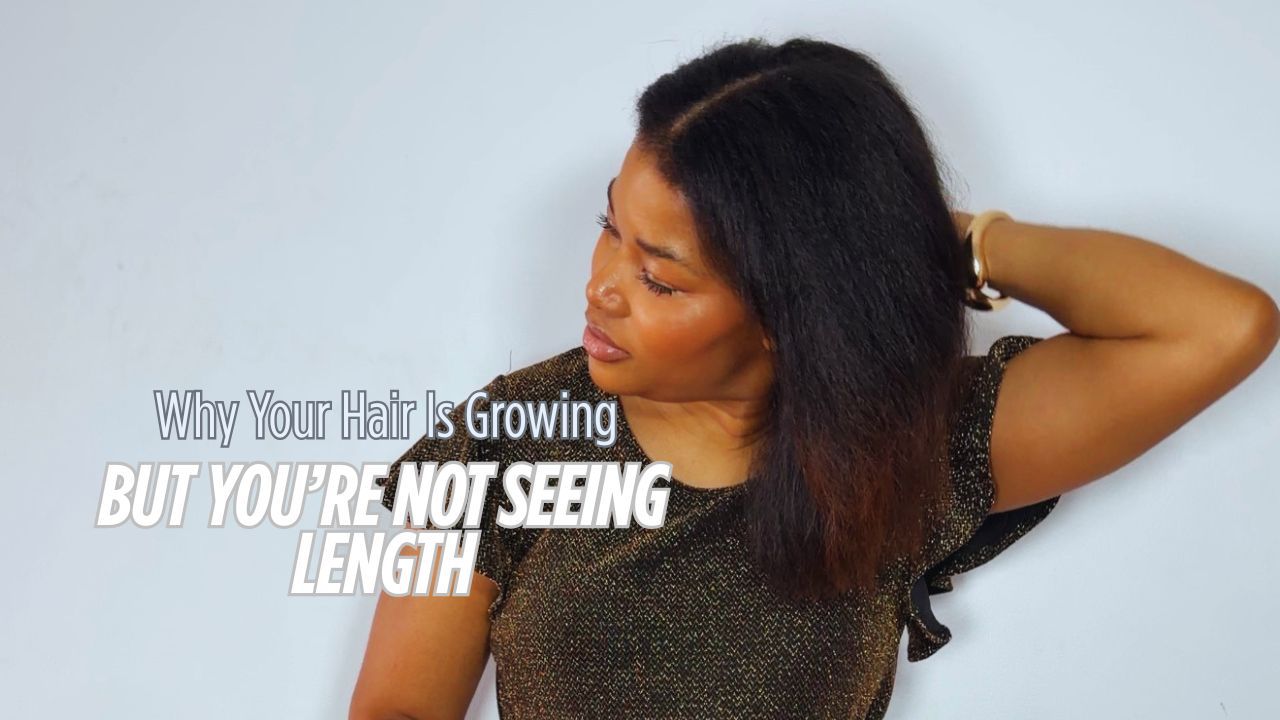
Have you ever felt like your natural hair grows, but it never seems to get any longer? You take care of your hair, follow a routine, and try different products, yet your length always seems to stop around the same spot.
If that sounds familiar, you’re not alone.
One of the biggest lessons I’ve learned throughout my natural hair journey is that hair growth and length retention are not the same thing. Your hair can continue growing from your scalp, but if you’re losing length through breakage faster than you’re retaining it, you might not see much progress.
For nearly eight years, my hair seemed to be stuck around collarbone length. I knew it was growing, but I struggled to understand why I wasn’t seeing the length I wanted.
Over time, I realized that I needed to pay less attention to making my hair grow faster and more attention to keeping the length I already had.
In this article, I’m sharing what I’ve learned about length retention, the habits that may contribute to breakage, and the changes I’ve been making to care for my natural hair differently.
Hair Growth vs. Length Retention: What’s the Difference?

Hair growth happens at the follicles in your scalp. Length retention is your ability to keep the length your hair gains over time.
Think of it this way: your hair can grow consistently, but if the ends keep breaking, you may not see much of a difference in its overall length.
For example, imagine that your hair has grown over several months. If you experience repeated breakage along the way, some of that progress may be lost before you notice it.
Shrinkage can also make it difficult to see how much length you’ve retained. Coily and tightly curled hair can look significantly shorter in its natural state than when it’s stretched.
This is why I don’t think we should judge our hair progress by appearance alone.
The goal isn’t to eliminate shrinkage or prevent every single strand from breaking. It’s to understand what your hair needs, reduce avoidable damage, and develop a routine that helps you retain more of the length you’re growing.
My Natural Hair Journey: Nearly Eight Years at Collarbone Length
For almost eight years, my hair seemed to have a strange relationship with length.
It would grow. I could see the new growth at my roots, and I could see the difference when I stretched my hair. Yet somehow, I kept finding myself around the same place: collarbone length.
It was frustrating.
I would look at other women with natural hair and wonder what they were doing differently. Some seemed to retain length effortlessly, while I felt like I had been having the same conversation with my hair for years.
Why isn’t my hair longer?
Why can’t I retain length?
Is my hair actually growing?
Eventually, I realized that I had been focusing on the wrong thing.
Instead of looking at my hair care habits as a whole, I was too focused on the result I wanted to see. I wanted longer hair, but I wasn’t always thinking about what happened to my hair between wash days, styling sessions, and everything else it went through.
That shift in perspective changed how I approached my hair.
My Twenties Were About Styling More Than Retaining
In my twenties, I wore wigs, extensions, and braids. Protective styling was a big part of my hair journey, and there’s nothing inherently wrong with any of those styles.
Wigs, braids, and extensions can be part of a healthy natural hair routine. The problem is that I wasn’t always consistent about caring for the hair underneath them.
My scalp has also always been prone to dandruff, and there were periods when my washing routine wasn’t as consistent as it needed to be.
Looking back, I can see that I was often more focused on how my hair looked than on what it needed to remain healthy.
You can have beautiful braids while neglecting the hair underneath. You can wear a wig with the intention of protecting your hair but overlook your scalp. You can install extensions to give your hair a break and still experience breakage if they’re too tight or removed roughly.
Protective styling isn’t automatically protective.
The care you give your hair before, during, and after a style matters just as much as the style itself.
Becoming More Intentional About My Hair
As I got older, I started paying more attention to how my hair responded to different routines and practices.
Instead of simply trying to make my hair look good for the day, I began thinking about how to maintain its condition over months and years.
I became more interested in consistency, conditioning, gentle detangling, and protecting my ends.
I also started recognizing that a product or routine working for someone else didn’t automatically mean it would work for me.
That lesson is important because it’s easy to keep buying products when you’re frustrated with your hair length. But sometimes the answer isn’t another product. Sometimes you need to look at how you’re handling your hair.
6 Reasons Your Natural Hair May Not Be Getting Longer
If your natural hair seems to have stopped growing, there are several things worth considering. More than one may be happening at the same time.

1. Breakage May Be Cancelling Out Your Growth
One of the biggest mistakes I made was thinking primarily about growth.
I wanted my hair to grow faster and finally get beyond that collarbone length plateau. But I eventually realized that protecting the hair I already had was just as important.
Breakage can happen for several reasons, including:
- Aggressive detangling
- Excessive manipulation
- Friction from clothing, bedding, and accessories
- Heat damage
- Chemical processing
- Tight hairstyles
- Rough takedowns
- Damaged or splitting ends
Even the way you handle your hair during wash day can make a difference over time.
If your hair repeatedly breaks along its length, you may struggle to see an increase in overall length, even while new hair continues to grow.
Pay attention to where breakage seems to occur and what your hair has been through. Rather than immediately buying a growth product, consider whether your routine is helping you keep the length you already have.
2. Shrinkage May Be Hiding Your Progress
If you have tightly coiled hair, you already know how dramatically your length can change depending on how you wear it.
My hair can look significantly shorter when I wear it in its natural state than when I stretch it.
That doesn’t mean I’ve lost length overnight. It means my curls and coils are contracting.
Shrinkage is a normal characteristic of textured hair, but it can make it difficult to judge progress when you’re comparing different hairstyles.
If you want to track your length, take photographs under similar conditions. For example, compare your hair when it’s stretched with another photograph of your hair stretched, rather than comparing a stretched style with a shrunken wash and go.
You don’t have to stretch your hair constantly or stop enjoying your natural texture. Just be mindful of shrinkage when assessing your progress.
Your hair may be longer than it appears.
3. Your Ends May Need More Attention
If your goal is longer natural hair, you eventually have to become interested in your ends.
Your ends are the oldest part of your hair. They’ve experienced more washing, detangling, styling, friction, and environmental exposure than the hair closest to your scalp.
If you’ve used heat or chemically processed your hair, those older sections may also have experienced additional stress.
This doesn’t mean you need to obsess over your ends or trim your hair constantly. It means paying attention to their condition.
Are your ends splitting? Do they tangle excessively? Are you noticing repeated breakage in the same areas?
Keep your hair conditioned, handle it gently, and avoid unnecessary friction and manipulation. If your ends are severely damaged, trimming may help remove the damaged sections, although trimming itself doesn’t make hair grow faster.
Length retention isn’t about keeping every millimetre of hair at all costs. It’s about maintaining hair in a condition that allows you to retain length over time.
4. Heat and Chemical Processing May Contribute to Damage
Heat styling and chemical processing can both affect the condition of your hair, particularly when combined with other sources of stress.
My hair has been chemically colored in the past, and stepping away from chemical color has given me an opportunity to pay closer attention to how my hair behaves.
I’m not someone who believes that coloring your hair automatically means you can’t have long, healthy natural hair. Many women color their hair and retain plenty of length.
However, chemical processing is worth considering if you’re struggling with breakage, especially when combined with frequent heat styling or rough handling.
The same goes for heat. Using heat doesn’t automatically mean you’ll experience heat damage, but excessive heat or repeated high heat exposure can damage the hair shaft. Damage can show up as increased breakage or changes in your hair’s texture.
As someone who enjoys experimenting with heat styling, I’ve become more intentional about how I approach it. I’m paying closer attention to temperature, technique, and the condition of my hair rather than treating every styling session the same way.
If heat is part of your routine, be mindful of how often you use it, follow the directions for your heat protectant, and avoid repeatedly applying high heat to the same sections.
You can also read my related guide on how to test for heat damage on natural hair.
5. Your Hair Care Routine May Need More Consistency
There was a time when my relationship with wash day was more sporadic than it is now.
Today, I understand that cleansing isn’t something I should avoid simply because I’m trying to retain length.
My scalp needs care, and my hair needs to be cleansed and conditioned regularly. The exact frequency will depend on the individual, their scalp, their styling products, and their lifestyle.
Someone who exercises frequently or uses a lot of styling products may need a different schedule from someone with different needs.
The goal isn’t to follow another person’s wash schedule perfectly. It’s to find a routine that keeps your scalp comfortable and your hair manageable.
Conditioning is also important because hair that is easier to manage may be less vulnerable to unnecessary mechanical stress during detangling and styling.
I’m learning to pay attention to how my hair feels and behaves rather than assuming that more products automatically mean better results.
Sometimes the answer isn’t another styling product. Sometimes it’s improving the basics.
6. Your Detangling Habits May Be Causing Unnecessary Breakage
If you’ve ever watched tightly coiled hair collect in a sink during detangling, you know how discouraging it can feel.
But detangling doesn’t have to be a battle.
I’ve become much more careful about working through my hair in sections and making sure it has enough slip before removing tangles.
I also try not to rush the process.
The goal isn’t to remove every tangle as quickly as possible. It’s to work through tangles while putting as little unnecessary stress on the hair as possible.
Depending on your hair and the products you’re using, that may mean detangling in sections, working from the ends toward the roots, and using your fingers or a suitable detangling tool.
Avoid forcing a brush or comb through stubborn tangles. If you encounter resistance, take your time and work through the section carefully.
Small adjustments to your handling can make a difference when you’re trying to retain length over time.
Shedding and Breakage Are Not the Same Thing
This distinction became especially important to me after experiencing postpartum hair shedding three times.
When you’ve spent years trying to retain length, seeing more hair come out can be alarming. You may start wondering whether your routine is failing or whether all your progress is disappearing.
But shedding and breakage are different.
Shedding occurs when a hair is released from its follicle as part of the hair growth cycle. A shed strand is generally a full-length strand, sometimes with a small bulb at one end.
Breakage occurs when the hair shaft snaps somewhere along its length. Broken hairs may be shorter and vary in length.
These clues can help you understand what you’re seeing, although they aren’t a definitive way to diagnose the cause of hair loss.
Postpartum shedding was a reminder that my hair journey wouldn’t always follow a predictable path. My body changed, my hair changed, and my routine had to change too.
If you’re experiencing sudden, excessive, patchy, or persistent hair loss, speak with a healthcare professional or dermatologist rather than assuming it’s caused by your hair care routine.
Sometimes the issue requires more than a change in shampoo or styling technique.
Protective Styles Can Help, but They Aren’t Magic
I’ve worn plenty of protective styles throughout my life, including wigs, braids, and extensions.
I’ve learned that the word protective doesn’t mean you can stop caring for your hair.
A good protective style should reduce unnecessary manipulation without creating a new source of damage.
If your braids are painfully tight, they may be putting too much tension on your hair and scalp. If you leave a style in for too long without caring for your scalp or hair, you may create additional problems. And if you rush through takedown and pull at your hair, you can cause breakage.
Protective styling is a tool, not a substitute for hair care.
Pay attention to how your scalp feels, how your hair behaves after takedown, and whether a particular style seems to leave you with more breakage.
You don’t have to give up protective styling to retain length. You just need to make sure the way you’re wearing and maintaining those styles supports your hair goals.
What I’m Doing Differently at 39
I’m 39 now, and one of the biggest things I’ve learned is that I can’t necessarily care for my hair the same way I did in my twenties.
That doesn’t mean hair automatically stops growing after 35. It means our lives, bodies, routines, and hair care needs can change over time.
After spending nearly eight years around collarbone length, I’m approaching my hair differently.
I’m focused on retaining what grows rather than constantly trying to make it grow faster.
Here’s what that looks like for me:
- I’m washing my hair consistently. I pay attention to my scalp and don’t avoid cleansing out of fear that washing will prevent length retention.
- I’m conditioning regularly. I want my hair to remain manageable and easier to handle.
- I’m being more careful with detangling. I work in sections and try not to rush through knots.
- I’m limiting unnecessary manipulation. My hair doesn’t need to be restyled every day.
- I’m protecting my ends. I’m more conscious of friction, tangling, and damage.
- I’m being more thoughtful about heat. I pay attention to my technique and how my hair responds.
- I’m trying to be consistent. Instead of constantly changing products, I’m giving my routine time and paying attention to what actually helps.
I’m also learning to be patient.
When you’ve spent years wanting longer hair, you want results immediately. You want to look in the mirror and suddenly see inches of progress.
But length retention is cumulative. The small things you do consistently can matter more than the dramatic things you do occasionally.
I want healthy hair that I can maintain. I want to understand what works for my hair rather than constantly wishing it behaved differently.
And I’m learning to appreciate progress that isn’t always immediately visible.
My Natural Hair Length Retention Checklist
If you’re not sure where to start, keep it simple.
- Look at your ends. Pay attention to splitting, excessive tangling, and repeated breakage.
- Pay attention to your scalp. Don’t ignore persistent itching, flaking, or unusual hair loss.
- Build a consistent wash routine. Choose a frequency that works for your scalp and hair.
- Condition regularly. Find products that help your hair remain manageable.
- Detangle gently. Work in sections and use enough slip to help remove tangles.
- Reduce unnecessary manipulation. Avoid repeatedly restyling your hair when it isn’t necessary.
- Be mindful of heat and chemical processing. Consider how often you use them and how your hair responds.
- Protect your ends. Reduce unnecessary friction and handle older sections carefully.
- Account for shrinkage. Compare your hair under similar conditions when tracking length.
- Give your routine time. Look for patterns in breakage, manageability, and overall condition rather than expecting immediate length changes.
You don’t have to change everything at once. Start with the habits most relevant to your hair and make adjustments based on what you observe.
Frequently Asked Questions About Hair Growth and Length Retention
Why is my natural hair growing but not getting longer?
Your hair may be growing at the scalp while you’re losing length through breakage. Heat damage, rough detangling, excessive manipulation, damaged ends, and tight hairstyles may all contribute. Shrinkage can also make it difficult to see your actual length.
How do I retain length on Type 4 hair?
Focus on gentle handling, regular cleansing and conditioning, reducing unnecessary manipulation, and protecting your ends. Protective styles can help reduce daily styling, but they should not create excessive tension or replace regular hair care.
How long does it take to see natural hair growth?
Hair grows gradually, and the rate varies between individuals. Visible length also depends on how much of that growth you retain. Consistent photographs taken under similar conditions can help you assess progress over time.
Does shrinkage mean my hair isn’t growing?
No. Shrinkage is the contraction of curly or coily hair, which makes it appear shorter than when stretched. It doesn’t automatically indicate a lack of growth.
Does hair stop growing after 35?
No. Turning 35 doesn’t automatically mean your hair stops growing. However, hair and scalp needs can change over time. If you notice unusual shedding, thinning, or persistent changes, consider seeking professional advice.
Should I stop using heat if I want longer natural hair?
Not necessarily. Heat styling can be part of a natural hair routine, but excessive heat and repeated exposure can damage the hair shaft. Consider your technique, temperature, frequency, and the condition of your hair when deciding how to use heat.
I’m Finally Looking at My Hair Differently
For a long time, I thought my hair was failing me.
I wondered why I couldn’t retain length like other women with natural hair. I wondered why I seemed to keep returning to the same collarbone length. I even questioned whether my hair was simply incapable of getting longer.
Now I understand my journey differently.
My hair has been through a lot: relaxers, wigs, extensions, braids, inconsistent washing, a dandruff-prone scalp, postpartum shedding three times, chemical color, heat, and years of learning through trial and error.
That’s not failure. That’s a history.
At 39, I’m learning to work with the hair I actually have rather than constantly wishing it behaved differently.
Maybe your hair journey looks different from mine. Maybe you’ve always had a consistent routine. Maybe you’ve experienced postpartum shedding, or perhaps you’re dealing with breakage from heat styling or protective styles.
Whatever your experience, before you assume your hair has stopped growing, take a closer look at what’s happening.
Your hair may be growing. You may simply need to focus on retaining more of that growth.
After nearly eight years of being stuck around collarbone length, that’s the lesson I’m carrying into this next chapter of my natural hair journey.
And I’m still learning.
Have you ever felt like your natural hair was stuck at the same length? Share your experience in the comments. I’d love to hear what you’ve learned about your own length retention journey.
You can also connect with me on Instagram for more of my natural hair and beauty journey.


Leave a Reply