If you have 4B or 4C natural hair, you probably know that detangling can quickly become the part of wash day you dread the most. One minute, you are working through your hair, and the next, your comb is stuck, your arms are tired, and you are wondering whether all the hair in your brush means your hair is breaking.
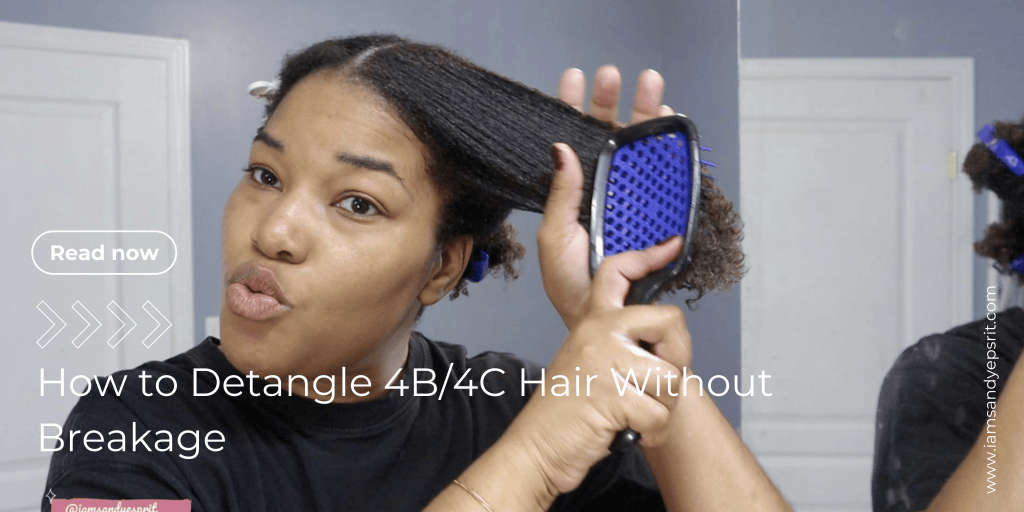
I get it. As someone who has been caring for 4B/4C natural hair for years, I know that maintaining your hair is about more than finding the right products. How you handle your hair matters, too.
And if you are trying to retain length, especially after experiencing heat damage or struggling to get past a particular length, unnecessary breakage is something you want to minimize.
The good news is that learning how to detangle 4B/4C hair without breakage does not require an expensive collection of products or an unnecessarily complicated routine. It starts with understanding your hair, giving it enough slip, working in manageable sections, and being patient when you encounter knots.
In this guide, I will walk you through how to detangle tightly coiled natural hair gently, which tools to use, common mistakes to avoid, and how to make detangling a more manageable part of your wash day.
Why Is 4B/4C Hair So Difficult to Detangle?
Type 4 natural hair has a tightly coiled or kinky texture. Individual strands can bend, curve, and wrap around neighbouring strands, making tangles and knots more likely to form.
With 4B hair, the strands often form sharp bends or a zigzag pattern. With 4C hair, the coils are typically very tight and may be less visibly defined without manipulation or styling products. Both textures can experience significant shrinkage, and shed hairs can become caught within the surrounding coils instead of sliding out easily.
This does not mean 4B or 4C hair is inherently unhealthy or incapable of growing long. It means your detangling technique needs to account for the way your hair behaves.
According to the American Academy of Dermatology’s guidance on Black hair care, textured hair benefits from gentle handling, regular conditioning, and practices that minimize damage.
Here are a few reasons detangling can become challenging:
- Shrinkage: Your hair can contract as it dries, bringing strands closer together and making knots harder to separate.
- Single-strand knots: Individual strands can curl around themselves, creating tiny knots that are difficult to remove without snapping the hair.
- Product buildup: Accumulated products can affect how your hair feels and make it harder to distribute conditioner evenly.
- Insufficient slip: Trying to comb through hair without enough lubrication creates unnecessary friction.
- Long periods without detangling: Shed hairs can remain trapped in your coils and combine with existing tangles.
- Previous damage: Hair weakened by excessive heat, chemical processing, or rough handling may be more vulnerable to breakage.
The goal is not to make your hair stop tangling completely. The goal is to remove tangles with as little unnecessary tension and damage as possible.
1. Start With the Right Detangling Conditions
One of the first things to consider is when you detangle your hair.
For many people with 4B/4C hair, detangling while the hair is damp or wet and coated with conditioner makes the process easier. Water helps hydrate the hair fibre, while conditioner improves slip and reduces the friction between strands.
However, the important part is not simply getting your hair wet. You also need a product that allows your fingers or detangling tool to move through your hair without excessive pulling.
Should you detangle 4C hair wet or dry?
There is no single rule that works for every head of hair, but many people with tightly coiled natural hair find that detangling during conditioning is easier than combing through dry, tangled hair.
I recommend experimenting with your hair to determine which approach gives you the least resistance.
For a typical wash day, you can:
- Divide your hair into sections before washing if it is particularly tangled.
- Gently remove obvious tangles with your fingers.
- Shampoo your scalp without aggressively rubbing the lengths together.
- Apply conditioner to your hair, concentrating on areas that need extra slip.
- Detangle gradually while the conditioner is providing enough lubrication.
If your hair becomes difficult to manage when fully saturated, try working with smaller sections and adjusting the amount of conditioner or water.
Remember that wet hair can also be vulnerable to damage from rough handling. Never use the fact that your hair is wet as a reason to force a comb through a knot.
2. Divide Your Hair Into Manageable Sections
If there is one habit I would encourage you to adopt, it is sectioning your hair before you begin detangling.
Trying to detangle your entire head at once makes it difficult to see what you are doing. You may repeatedly pull on the same knot, miss tangles underneath, or accidentally combine already-detangled hair with hair that still needs attention.
Sectioning gives you more control.
Depending on your hair’s density, length, and current condition, start with four to eight sections. If your hair is particularly dense or tangled, smaller sections may be easier to manage.
Here is how to do it:
- Use your fingers or the end of a sectioning comb to divide your hair.
- Secure each section with a clip or loosely twist it.
- Leave one section out and work on that section alone.
- Once you have finished detangling, loosely twist or braid the section again.
- Move on to the next section.
Do not worry about making perfectly straight parts. These sections are for managing your hair, not creating a finished hairstyle.
The smaller the section, the easier it can be to identify and remove individual knots without pulling on neighbouring strands.
If you are detangling a child’s natural hair, sectioning can also make wash day feel less overwhelming because you can work through one manageable area at a time.
3. Use a Conditioner With Enough Slip
Your detangling product does not need to be expensive, but it should help your strands glide past one another.
Slip refers to how easily your fingers or a comb move through the hair. A conditioner with good slip can make a noticeable difference when working through tangles.
Look for a rinse-out conditioner or detangling product that leaves your hair feeling easier to separate without requiring excessive force.
You may also benefit from a leave-in conditioner if your hair needs additional manageability after washing. The American Academy of Dermatology explains that leave-in conditioners can help make hair easier to comb and reduce breakage associated with grooming. Read its dermatologist-backed guide to leave-in conditioner.
A few things to remember:
- Apply enough conditioner to coat the section you are working on.
- Add a little water if the product begins to feel sticky or difficult to distribute.
- Give the conditioner time to spread through the strands according to the product instructions.
- Add more product when you encounter resistance instead of trying to force your way through a knot.
You do not need to use several products at once. Start with a conditioner that works for your hair and adjust your routine based on how your strands respond.
Do oils replace conditioner?
Not necessarily. Oils can help lubricate the hair or reduce friction in some routines, but they do not provide the same conditioning benefits as every rinse-out or leave-in conditioner.
If your hair feels dry and difficult to detangle, adding more oil is not automatically the answer. Consider whether your hair needs water, conditioning, product buildup removal, or a gentler technique.
4. Finger Detangle Before Reaching for Your Comb
Finger detangling is particularly useful when you encounter larger knots or areas where several strands have wrapped around one another.
Your fingers allow you to feel resistance before you pull on a knot. Instead of immediately trying to force a tool through it, you can gently separate the strands and work out the tangle in smaller pieces.
Here is how I would approach it:
- Take a small, conditioned section of hair.
- Hold the section gently so you are not pulling directly on your scalp.
- Begin at the ends and feel for knots with your fingers.
- Carefully separate the strands surrounding each knot.
- Work through the tangle little by little.
- Once your fingers can move through the section more easily, decide whether you need a comb or brush to finish.
Finger detangling can take longer, especially if you have dense or long hair. However, it gives you more control over how much tension you apply.
You also do not have to finger detangle every strand perfectly before using a tool. The point is to loosen the major knots first, making the next step easier.
5. Always Work From the Ends Toward the Roots
This is one of the most important techniques to learn when detangling 4B/4C hair.
If you begin combing from the roots and pull downward, you can push loose strands and tangles together as the comb moves through the hair. When it reaches a knot, you may end up pulling several inches of hair at once.
Starting at the ends allows you to address the smaller tangles first.
Follow this process:
- Start with the bottom inch or two of the section.
- Gently remove any knots in that area.
- Once the ends are clear, move slightly higher.
- Continue working upward in small increments.
- If the comb catches, stop and use your fingers to loosen the knot before continuing.
Hold the section above the area you are detangling. This helps reduce the amount of pulling transferred to your scalp and roots.
The Canadian Dermatology Association’s hair care guidance also recommends using conditioner to facilitate combing and starting at the ends before gradually working toward the scalp.
You may find that this technique takes more time than running a comb from root to tip. That is fine. The purpose is to reduce unnecessary tension, not to finish as quickly as possible.
6. Choose the Right Detangling Tool
There is no single detangling tool that every person with 4B/4C hair must use. What works best depends on your hair density, length, condition, and personal preference.
Wide-tooth comb
A wide-tooth comb is a useful option for gently working through conditioned, tightly coiled hair. Its wider spacing can help you remove tangles without immediately forcing the strands through closely spaced teeth.
Use it slowly, beginning at the ends.
Flexible detangling brush
Some people prefer flexible detangling brushes because the bristles or rows can move through sections of hair while allowing some flexibility when resistance occurs.
If you prefer a brush, choose one that works with your hair rather than one you have to force through it. Use it with adequate slip, in small sections, and stop when you encounter a stubborn knot.
Your fingers
Never underestimate your fingers as a detangling tool. They are particularly useful for identifying single-strand knots, separating shed hairs, and loosening larger tangles.
You can use your fingers alone or combine finger detangling with a comb or brush.
The most important consideration is not whether you own a particular viral hair tool. It is whether your chosen tool moves through your hair without excessive pulling.
7. Pay Extra Attention to Single-Strand Knots
Single-strand knots are those tiny knots that form when an individual strand curls around itself.
They can be frustrating because they are often difficult to see, particularly on tightly coiled hair. You might feel them when running your fingers along a section or notice that a comb repeatedly catches at the same point.
A few habits may help reduce the conditions that contribute to knots:
- Keep your ends conditioned and manageable.
- Detangle regularly enough to prevent shed hairs and existing tangles from accumulating.
- Avoid repeatedly manipulating the same section.
- Consider loose twists or braids when your hair is not being actively styled.
- Be gentle when separating tangled ends.
If you encounter a single-strand knot, do not automatically pull it apart or snap the strand. Try gently loosening it with your fingers.
Some knots may not come apart easily. If you consistently experience numerous knots and split ends, consider speaking with a stylist experienced in natural hair about whether a small trim would help.
You do not need to cut your hair every time you find a knot. The aim is to protect the length you have while recognizing that severely damaged ends cannot always be restored with products.
8. Keep Your Hair From Retangling After Detangling
Have you ever spent what feels like forever detangling a section, only to discover that it has tangled again before you finish the rest of your head?
This is why I recommend securing each section once you have finished working through it.
You can loosely twist or braid the section and secure it with a clip. Avoid making the twists too tight, especially around your edges and scalp.
Keeping completed sections separate helps prevent them from mixing with the hair you have not detangled yet.
It can also help to:
- Avoid rubbing your hair together aggressively while shampooing.
- Keep sections organized while applying conditioner.
- Gently squeeze excess water from your hair instead of rubbing it with a towel.
- Use a leave-in conditioner if your routine benefits from one.
- Protect your hair in a loose, comfortable style when you are finished.
Your hair does not need to remain stretched at all times. Shrinkage is a normal characteristic of tightly coiled hair. The goal is to manage tangles without treating your natural texture as a problem that needs to be corrected.
9. Avoid These Common Detangling Mistakes
Sometimes, reducing breakage is less about adding another product and more about stopping the habits that make detangling harder.
Detangling in a rush
Trying to finish your entire head in a few minutes encourages rough handling. Give yourself enough time, particularly if you have not detangled your hair in a while.
Forcing a comb through knots
If your comb gets stuck, do not pull harder. Stop, add more slip if needed, and gently loosen the knot with your fingers.
Using too little conditioner
If your hair feels rough and the comb is catching repeatedly, the section may need more lubrication or a different technique.
Waiting until your hair is severely tangled
Long stretches without detangling can allow shed hairs and existing knots to accumulate. Find a wash-day schedule that works for your scalp and lifestyle rather than waiting until your hair becomes difficult to manage.
The American Academy of Dermatology recommends washing Black hair based on its needs, using conditioner, and handling textured hair gently. Its Black hair care recommendations are a helpful starting point.
Assuming every strand in your comb is breakage
Hair shedding and breakage are different. Naturally shed hairs may remain trapped in tightly coiled hair until you detangle. Broken strands, on the other hand, have snapped along the length of the hair.
A small amount of shedding during detangling is normal. However, if you notice an unusual increase in hair loss, thinning areas, or persistent scalp symptoms, consult a dermatologist rather than assuming your detangling technique is the only cause.
10. How Often Should You Detangle 4B/4C Hair?
Your ideal detangling frequency depends on your hairstyle, how quickly your hair tangles, your wash routine, and your scalp’s needs.
For some people, detangling during each wash day works well. Others may need to gently separate their hair more frequently, particularly if they wear their hair loose or notice that knots form quickly.
You do not have to comb your hair every day to keep it healthy.
If you wear twists or braids, you may be able to maintain your hair with less frequent full detangling between wash days, provided you keep your scalp clean and avoid allowing the hair to become severely tangled.
The important thing is to find a routine that prevents tangles from accumulating without creating unnecessary manipulation.
If you are working toward length retention, consistency is more useful than repeatedly changing your routine in search of a miracle product.
Final Thoughts: Detangling 4B/4C Hair Without Breakage Takes Patience
Learning how to detangle 4B/4C hair without breakage is not about finding a magical brush or buying every product marketed toward natural hair.
It is about understanding your hair and handling it with care.
Start with manageable sections. Give your hair enough slip. Use your fingers to loosen stubborn knots, work from the ends toward the roots, and stop whenever you feel excessive resistance.
And remember, you do not have to finish your entire head in record time. Taking a little longer to detangle gently may help you avoid unnecessary damage.
As someone who has spent years learning how to care for 4B/4C hair, I believe length retention comes down to more than growth products. Your everyday habits matter, too.
You cannot prevent every strand from shedding or every knot from forming, but you can make choices that help reduce unnecessary breakage and make wash day more manageable.
Your goal is not perfectly tangle-free hair. Your goal is hair you can care for consistently while protecting the length you are working so hard to retain.
Frequently Asked Questions
Should I detangle 4C hair before or after shampooing?
If your hair is heavily tangled, gently separating it into sections before shampooing may help. You can then complete most of your detangling while your hair is conditioned. Choose the approach that gives you the least resistance and avoid aggressive combing.
Is finger detangling better than using a brush?
Finger detangling gives you more control when loosening knots because you can feel resistance directly. A suitable detangling brush can also work well when used gently on conditioned hair. You can combine both methods.
Can I detangle 4B/4C hair without conditioner?
You can separate some tangles with your fingers, but conditioner or a suitable detangling product often makes the process easier by improving slip. If your hair repeatedly catches or feels rough, consider adding a product that improves manageability.
Why does so much hair come out when I detangle?
Some of the hair you see may be naturally shed hair that became trapped in your coils. Other strands may have broken because of tension, damage, or rough handling. If the amount of hair loss has noticeably increased or you see thinning, consult a dermatologist.
Does detangling help with length retention?
Gentle detangling can help reduce avoidable mechanical breakage. It does not make hair grow faster at the scalp, but preserving more of the length your hair grows can help you retain length over time.
What is the best comb for 4C hair?
A wide-tooth comb is a useful starting point for many people with 4C hair. A flexible detangling brush or your fingers may also work well. The best option is the one that helps you remove tangles with minimal pulling.
More natural hair care resources
If you are working on your natural hair routine, you may also enjoy these related guides:
- How to Retain Length With 4B/4C Natural Hair
- How to Care for Heat-Damaged Natural Hair
- How to Build a Wash-Day Routine for 4B/4C Hair
These internal links should point to relevant posts on your own website once those URLs are confirmed.
Sources and further reading
For more information on caring for textured hair, consult these dermatology resources:
- American Academy of Dermatology: Black Hair Care Tips
- American Academy of Dermatology: Healthy Hair Tips
- American Academy of Dermatology: Leave-In Conditioner Tips
- Canadian Dermatology Association: Hair Care
These sources provide additional guidance on conditioning, gentle grooming, and reducing damage. They complement personal experience but do not replace advice from a dermatologist when you have persistent hair loss or scalp concerns.


Leave a Reply