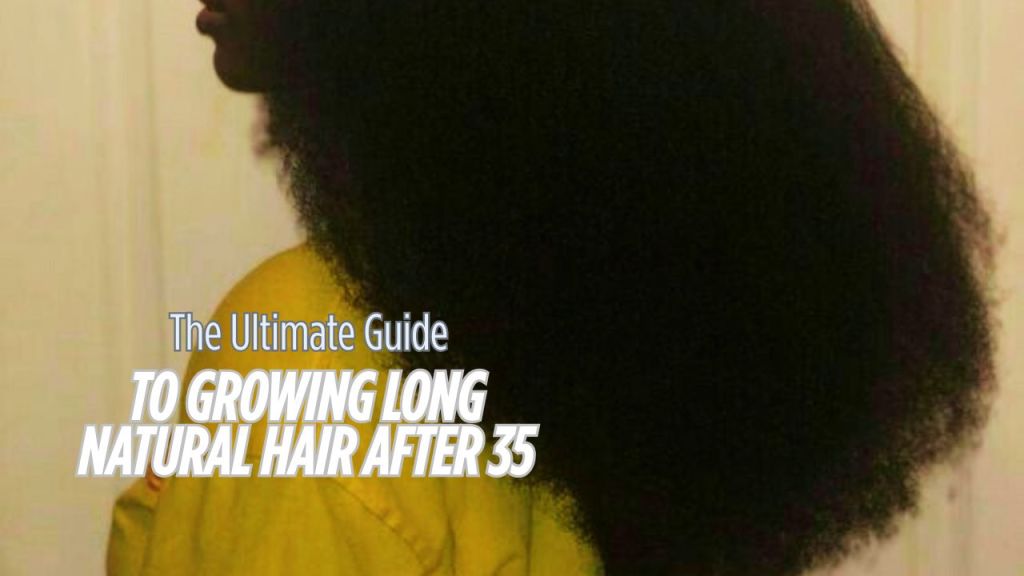
If you’re trying to grow long natural hair after 35, you’ve probably noticed that what worked for your hair in your twenties may not work quite the same way now.
Maybe your hair seems to grow slowly. Maybe you feel like you’ve been stuck at the same length for years. Maybe you reach collarbone length and suddenly it feels like your hair refuses to go any further.
I know that feeling.
As someone with naturally curly, coily hair, I’ve spent plenty of time wondering why my hair seems to have a favorite stopping point. For me, that point often seems to be around collarbone length. I can grow hair, but retaining that length is another conversation entirely.
And that distinction is important.
Because when we talk about growing long natural hair, we often focus almost entirely on growth. How do I make my hair grow faster? What oil will make it grow? What supplement should I take? How often should I massage my scalp?
But hair growth is only half of the equation.
If your hair is growing but breaking at the same rate, you may never see the length you’re working so hard to achieve.
That’s why, after 35, I’m much more interested in healthy hair than chasing a specific length.
Long hair can be beautiful, but healthy hair is the real goal.
So if you’re trying to grow and retain length with natural hair after 35, here’s what I’ve learned.
Does Natural Hair Grow More Slowly After 35?
One of the biggest questions people have is whether hair naturally stops growing as we get older.
The answer is more complicated than simply saying, “Yes.”
Hair grows from the follicle, and the rate of growth can vary from person to person. Age can influence the hair cycle, but so can genetics, hormones, nutrition, stress, health, medications, scalp health, and your hair-care practices.
And there’s another factor that is especially important for natural hair:
Breakage.
Your hair may be growing perfectly well from your scalp while the ends are breaking before you ever get to enjoy that new length.
This is particularly important for tightly curled and coily textures because the twists and turns of the hair strand can make it more vulnerable to dryness, tangling and mechanical damage.
So if you’ve been saying, “My hair won’t grow,” it may be worth asking a different question:
Is my hair actually not growing, or am I struggling to retain the length that I’m growing?
That question completely changed the way I approach my own hair.
My Goal Is Healthy Hair, Not Just Long Hair
I used to think about length much more than I do now.
Of course I would love to have longer hair. Who wouldn’t?
But I don’t want long hair at the expense of healthy hair.
I don’t want to reach a certain length only to have thin, see-through ends, excessive breakage, or damaged strands that make maintaining that length impossible.
I would rather have hair that is moisturized, strong, manageable and healthy—even if it takes longer to reach my desired length.
That mindset takes some of the pressure off.
Instead of constantly checking whether my hair has grown another inch, I can pay attention to the things that actually help me retain the hair I already have.
That means taking care of my scalp, minimizing unnecessary manipulation, protecting my ends, maintaining moisture and being more intentional about how I handle my hair.
1. Focus on Length Retention
If your goal is growing long natural hair after 35, length retention should be one of your biggest priorities.
Hair naturally grows.
The challenge is keeping that hair on your head.
Think about it this way: If your hair grows approximately half an inch over a period of time but you experience significant breakage during that same period, you may not notice any increase in length.
That can make it seem as though your hair has stopped growing.
Length retention means preserving the hair you already have long enough to see your growth.
That requires paying attention to your ends because they are the oldest and often most fragile part of your hair.
If your ends are constantly splitting, snapping or tangling, growing longer hair becomes much more difficult.
2. Don’t Ignore Your Scalp
Healthy hair starts at the scalp.
That doesn’t mean you need an elaborate twelve-step scalp routine.
For me, scalp care is much more about keeping the scalp clean, comfortable and healthy.
Product buildup, excess oil, sweat and environmental debris can accumulate on the scalp. Regular cleansing can help keep the scalp environment healthy.
And if you are experiencing persistent itching, excessive flaking, inflammation, sudden shedding or noticeable thinning, don’t assume you simply need a better hair product.
Sometimes the issue isn’t your routine.
It may be something that needs professional attention.
Your scalp deserves just as much attention as the strands hanging from it.
3. Learn the Difference Between Dryness and Damage
This is something I wish more people talked about when discussing natural hair.
Dry hair and damaged hair aren’t necessarily the same thing.
Your hair can feel dry because it needs conditioning, moisture or a change in how you’re caring for it. Damage can involve structural changes to the hair strand caused by things such as chemical processing, excessive heat, mechanical stress or other forms of wear.
And sometimes you can have both.
That’s why throwing another moisturizing product at severely damaged hair isn’t always the answer.
You need to understand what your hair is actually asking for.
Sometimes it needs moisture.
Sometimes it needs conditioning.
Sometimes it needs strengthening.
Sometimes it needs less manipulation.
And sometimes it simply needs to be left alone.
4. Be Careful With Heat
I am not someone who believes natural hair has to completely avoid heat.
I use heat.
But technique matters.
There is a huge difference between using heat intentionally and repeatedly exposing your hair to high temperatures without considering the condition of the hair.
If you’re using a blow dryer, diffuser, flat iron or other heat tool, pay attention to temperature, frequency and technique.
Heat protectant is also an important part of a heat routine.
And remember: Heat damage isn’t always immediately obvious.
You may not notice a problem after one use. Damage can accumulate over time.
If you love wearing your natural hair stretched, blow-dried or diffused, you don’t necessarily have to give that up. Instead, learn how to use heat in a way that minimizes unnecessary damage.
5. Don’t Underestimate Detangling
For natural hair, detangling can be one of the most damaging parts of the routine if you’re not careful.
Think about how many times you’ve heard a snapping sound while brushing through your hair.
That isn’t just noise.
That’s hair.
The goal isn’t to avoid detangling altogether. The goal is to make the process gentler.
Use enough slip to make the process manageable. Work in sections when necessary. Start from the ends and gradually work your way upward instead of attacking the roots first.
And be mindful of the tools you’re using.
A tool that works beautifully for one person’s hair may be completely wrong for yours.
The best detangling routine is the one that allows you to remove shed hair and tangles without unnecessarily sacrificing healthy strands.
6. Protect Your Ends
If you’re trying to retain length, your ends deserve attention.
They’re the oldest part of your hair and they’ve been through everything your hair has experienced before you even reach them.
Washing.
Detangling.
Sleeping.
Styling.
Heat.
Sun exposure.
Manipulation.
All of it.
That is why protective styling can be useful for some people.
But protective styling isn’t automatically protective.
A style that is too tight, too heavy or left in too long can create its own problems.
Braids, twists, buns and other low-manipulation styles should feel comfortable.
If your scalp hurts, your edges are being pulled or your hair is breaking around the style, that’s not protection.
That’s stress.
7. Stop Treating Every Viral Hair Hack Like a Requirement
The natural hair internet can make you feel like you’re constantly doing something wrong.
One week it’s rice water.
The next week it’s rosemary oil.
Then it’s scalp massages.
Then it’s a new growth serum.
Then someone is telling you that you need to wash your hair every day.
It can become exhausting.
And honestly, your hair doesn’t need you to try every viral trend.
You need to understand your hair.
Pay attention to what makes your hair feel healthy and what consistently leads to dryness, breakage or irritation.
A simple routine that you can actually maintain will usually serve you better than constantly changing products because something went viral.
8. Don’t Forget About Your Diet
Hair is not separate from the rest of your body.
Your body needs adequate nutrition to support normal hair growth.
That doesn’t mean you need to start taking every hair-growth supplement you see on social media.
Instead, focus on eating a balanced diet that provides the nutrients your body needs.
Protein is especially important because hair is primarily made of keratin, a protein.
If you have concerns about your diet, excessive shedding or changes in your hair, it’s worth discussing them with a qualified healthcare professional rather than trying to diagnose yourself based on a TikTok video.
More supplements aren’t automatically better.
9. Your Hormones Can Change
One of the reasons hair care after 35 can feel different is that your body can change.
Hormonal changes can influence hair growth, shedding, density and texture.
That doesn’t mean everyone over 35 will experience hair loss or thinning.
It simply means that your hair isn’t operating in isolation from the rest of your body.
If you notice sudden or significant changes in your hair, don’t automatically blame your shampoo.
Pay attention to what’s happening with your overall health and speak with a healthcare professional if something seems unusual.
10. Don’t Be Afraid to Trim
I know.
You want longer hair.
The last thing you want to hear is, “You need a trim.”
But trimming damaged ends isn’t the enemy of length retention.
If your ends are severely damaged, continuing to hold onto them doesn’t necessarily mean you’re preserving length.
Sometimes you’re simply preserving damage.
The goal isn’t to constantly cut your hair.
It’s to remove what needs to be removed while maintaining as much healthy length as possible.
And there is no universal trimming schedule that every person needs to follow.
Your hair’s condition matters more than an arbitrary calendar.
11. Pay Attention to How You Sleep
Your nighttime routine can also affect length retention.
Think about how much friction your hair experiences while you’re sleeping.
If your hair is constantly rubbing against rough fabric, that repeated friction can contribute to tangling and breakage.
A satin or silk bonnet, scarf or pillowcase can help reduce friction.
You don’t need a complicated nighttime routine.
Even something as simple as putting your hair into a loose, low-manipulation style before bed can make a difference.
The less unnecessary manipulation your hair experiences, the better your chances of retaining the hair you’re growing.
12. Don’t Obsess Over Your Growth Rate
This may be the hardest piece of advice for anyone trying to grow long natural hair.
Stop checking your length every five minutes.
Okay, maybe not literally every five minutes.
But you get the point.
Your hair doesn’t need to constantly prove that it’s growing.
Natural hair shrinks.
Curl patterns change how long your hair appears.
Different hairstyles can make the same amount of hair look dramatically different.
Instead of obsessing over length, pay attention to other signs of healthy hair.
Is your hair breaking less?
Does it feel stronger?
Are your ends healthier?
Is your scalp comfortable?
Is your hair easier to manage?
Are you retaining more hair when you detangle?
Those things matter.
What If You’re Stuck at Collarbone Length?
This is where I have to get personal.
I sometimes feel like my hair has decided that collarbone length is where it wants to live.
I can grow it.
Then I hit that point where maintaining the length becomes difficult.
And instead of pretending I have discovered some magical secret that will suddenly make my hair grow to my waist, I’d rather be honest about where I am.
Maybe my hair can grow longer.
Maybe I need to improve my length retention.
Maybe my routine needs some adjustments.
Maybe my ends need more attention.
Maybe there are things about my hair that I still haven’t figured out.
And that’s okay.
Because my hair doesn’t have to reach my waist to be healthy.
I would rather have healthy collarbone-length hair than damaged waist-length hair.
That doesn’t mean I have given up on length.
It means length isn’t the only measurement of success.
A Healthy Hair Routine After 35 Doesn’t Have to Be Complicated
If you’re overwhelmed by everything you’re supposedly supposed to do for your natural hair, simplify.
Start with the basics.
Cleanse your scalp regularly.
Condition your hair.
Keep your hair adequately moisturized.
Detangle gently.
Protect your ends.
Limit unnecessary manipulation.
Use heat intentionally.
Pay attention to your scalp.
Eat a balanced diet.
Get professional help when something doesn’t seem right.
And most importantly, learn your hair.
Your hair doesn’t need the most expensive products.
It doesn’t need every trending ingredient.
It doesn’t need a shelf full of products that you barely use.
It needs consistency.
Final Thoughts: Grow the Hair You Have, Not the Hair Social Media Promises
Growing long natural hair after 35 isn’t necessarily about finding a magical product that suddenly changes your hair growth rate.
For many of us, the bigger challenge is learning how to retain the hair we’re already growing.
And that’s where I’m putting much more of my attention these days.
I still want longer hair.
Of course I do.
But I don’t want to sacrifice the health of my hair just to say that I reached a particular length.
I’m learning to appreciate the process.
I’m learning that healthy hair can look different from one person to the next.
I’m learning that my hair doesn’t have to behave like someone else’s hair.
And I’m learning that reaching a certain age doesn’t mean your hair journey is over.
If anything, getting older can give you a better understanding of what your hair actually needs.
So if you’re sitting there wondering why your natural hair hasn’t grown past a certain point, don’t immediately assume your hair has stopped growing.
Look at the bigger picture.
Look at your scalp.
Look at your ends.
Look at your routine.
Look at your breakage.
Look at how you handle your hair.
And most importantly, ask yourself whether you’re measuring success by length alone.
Because sometimes the real goal isn’t simply to grow long hair.
It’s to grow healthy hair that you can actually keep.
And for me, that’s a goal worth pursuing at any age.


Leave a Reply